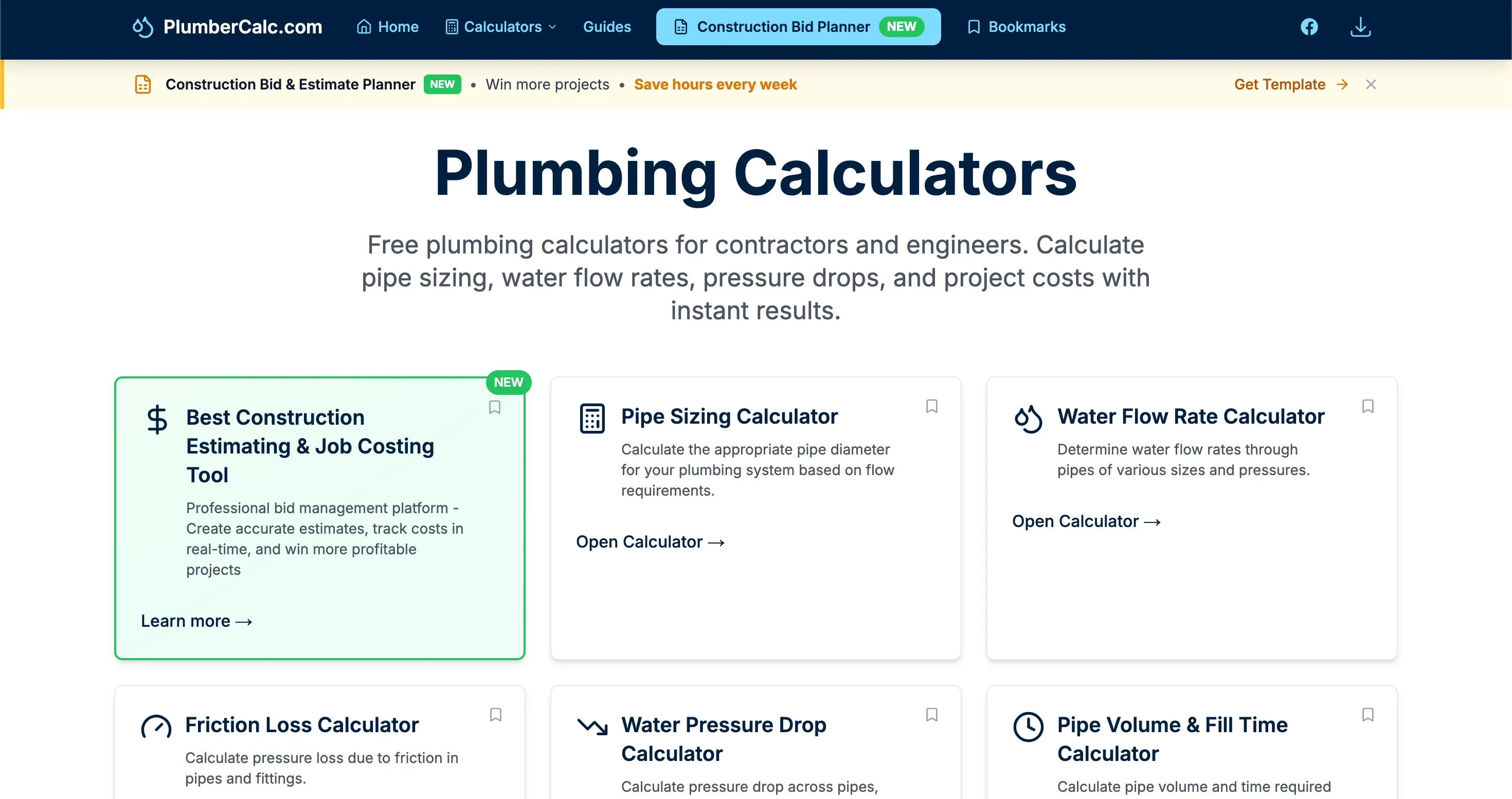
Free professional plumbing calculators for pipe sizing, flow rate, pressure drop, and more, trusted by contractors and engineers.
The website review directory that helps you rank on Google, ChatGPT, Claude, Gemini & Perplexity with dofollow backlinks and AI reviews.
Revenue analytics for SaaS founders. See what actually drives your growth.
Capture Studio pairs a 120 FPS Windows screen recorder with a multi-track editor and fully on-device AI narration, auto-zoom, captions, and voice cloning for tutorial and product-demo workflows.
Capture Studio pairs a 120 FPS Windows screen recorder with a multi-track editor and fully on-device AI narration, auto-zoom, captions, and voice cloning for tutorial and product-demo workflows.
Get listed across 100+ startup directories, submitted by hand. Permanent dofollow backlinks and +25 domain rating on average.
Submit your website to get discovered by thousands of potential customers and boost your SEO.
Get ListedTransactional email and SMS API for developers with one-time codes, marketing campaigns, and a unified suppression list.
Transactional email and SMS API for developers with one-time codes, marketing campaigns, and a unified suppression list.
WakeSharp turns alarm dismissal into mandatory missions — math, puzzles, photo checks or real steps — then scores post-wake cognition against a personal baseline, with calendar-aware scheduling on iOS and Android.
WakeSharp turns alarm dismissal into mandatory missions — math, puzzles, photo checks or real steps — then scores post-wake cognition against a personal baseline, with calendar-aware scheduling on iOS and Android.
Ideavo is a free, model-agnostic AI app builder that generates full-stack web, mobile, and internal tool projects with exportable code and bring-your-own-key LLM access.
Ideavo is a free, model-agnostic AI app builder that generates full-stack web, mobile, and internal tool projects with exportable code and bring-your-own-key LLM access.
PlumberCalc is a free, web-based suite of engineering calculators designed specifically for plumbing professionals, contractors, and engineers. The platform addresses a common pain point: the need for quick, accurate hydraulic and plumbing calculations without the expense of specialized software or the hassle of manual formula work. It positions itself as a comprehensive, always-free alternative to paid tools like Plumbing Calculator Pro or standalone engineering software, offering a wide range of calculators that cover everything from pipe sizing and flow rate to water heater sizing and gas line sizing.
The site is built for practical, on-the-job use. It's mobile-responsive, works offline once loaded, and provides instant results based on industry-standard formulas like Hazen-Williams and Manning's equation. This makes it a valuable resource for plumbers in the field, engineers in the office, and even DIY homeowners tackling plumbing projects. With over 30 calculators and a growing library of how-to guides, PlumberCalc aims to be the go-to free resource for plumbing calculations.
What sets it apart is its breadth and accessibility. While many single-purpose calculators exist online, PlumberCalc consolidates a wide array of tools into one cohesive platform, all free with no sign-up required. The inclusion of code-referenced standards (IPC, ASME) adds credibility, and the offline capability is a practical advantage for job sites with poor connectivity. This review will explore its key features, usability, and overall value.
Comprehensive Calculator Library: PlumberCalc hosts over 30 specialized calculators, each targeting a specific plumbing calculation. These include the Pipe Sizing Calculator, Water Flow Rate Calculator, Friction Loss Calculator, Pressure Drop Calculator, Pipe Volume & Fill Time Calculator, Expansion Tank Sizing, Water Heater Sizing, Fixture Unit Load, Drainage Slope, Gas Line Sizing, Backflow Preventer Sizing, Septic System Sizing, Sump Pump Sizing, Hot Water Recirculation, Pipe Insulation Heat Loss, Tankless Water Heater Flow Rate, BTU Heating Load, Grease Trap Sizing, Water Hammer, Pump Head & Power, Glycol Calculator, Imperial/Metric Converter, HVAC Converter, Schedule 40 Pipe Sizes, Water Properties, Pipe Offset, Pipe Thermal Expansion, and DWV Pipe Sizing. This breadth ensures that most common plumbing calculations are covered in one place.
Instant, Accurate Calculations: Each calculator uses industry-standard engineering formulas. For example, the pipe sizing tool likely employs the Hazen-Williams equation for pressure flow, while the drainage slope calculator uses Manning's formula for open channel flow. The results are displayed instantly as inputs are adjusted, providing real-time feedback. This is crucial for professionals who need quick answers without manual computation errors.
Mobile-Ready and Offline Capability: The site is fully responsive, working seamlessly on smartphones and tablets. A standout feature is that once a page is loaded, all calculators function offline. This is a huge advantage for plumbers working in basements or remote locations where internet access is unreliable. The site also supports installation as a PWA (Progressive Web App), allowing users to add it to their home screen for quick access.
Code Compliance and Standards: The calculators are designed to align with the International Plumbing Code (IPC) and ASME guidelines. The site explicitly mentions these standards in its engineering section, giving users confidence that the results are suitable for permit applications and code compliance. However, it also advises verifying with local codes, as requirements can vary by jurisdiction.
Additional Resources: Beyond calculators, PlumberCalc offers a collection of how-to guides (e.g., "How to Size Water Pipes", "How to Calculate Drainage Slope") and cost guides for pipe installation. These resources provide educational value and help users understand the underlying principles. The site also features a Construction Bid Planner, a newer tool for creating estimates and tracking costs, which expands its utility beyond pure calculation.
Bookmarking and Sharing: Users can bookmark calculators for quick access, and the site includes social sharing options. This is a small but convenient feature for professionals who frequently use specific tools.
Using PlumberCalc is straightforward. There's no sign-up or login required; users simply navigate to the desired calculator from the homepage or the dropdown menu. Each calculator presents a clean interface with input fields for parameters like flow rate, pipe length, material, and pressure. As the user enters values, the calculator instantly computes the result, displaying it alongside relevant derived values (e.g., velocity, pressure drop).
For example, in the Pipe Sizing Calculator, a user would enter the required flow rate in GPM, select the pipe material (copper, PEX, PVC, etc.), and input the pipe length. The tool then recommends a pipe diameter, shows the resulting velocity, and calculates the pressure drop. This immediate feedback allows for quick iteration, such as testing different materials or flow rates to see how they affect sizing.
The site's navigation is intuitive, with calculators grouped into categories like "Sizing & Heating" and "Converters & References" in the footer. The homepage also lists popular calculators with brief descriptions. For users new to plumbing calculations, the how-to guides provide step-by-step instructions, making the tools accessible even to those without deep engineering knowledge.
One minor learning curve is understanding the specific inputs required for each calculator, but the interface is self-explanatory, and the guides help bridge any gaps. Overall, the workflow is efficient and user-friendly, designed for quick, on-the-fly calculations.
A Plumber on a Job Site: A plumber installing a new water supply line needs to determine the correct pipe size for a given flow rate and distance. Using the Pipe Sizing Calculator on a smartphone, they input the required GPM and pipe length, select copper as the material, and instantly get the recommended diameter and pressure drop. This ensures the installation meets code and performs efficiently, all without returning to the office.
A Mechanical Engineer Designing a System: An engineer designing a commercial building's plumbing system needs to calculate friction loss across a complex network of pipes and fittings. The Friction Loss Calculator and Pressure Drop Calculator allow them to input pipe lengths, diameters, and fitting types to obtain accurate pressure losses, helping them select appropriate pumps and ensure adequate pressure at fixtures.
A Homeowner Planning a Bathroom Remodel: A homeowner planning a bathroom remodel wants to ensure their new fixtures will have adequate water pressure. They use the Water Flow Rate Calculator to estimate flow rates based on pipe size and pressure, and the Fixture Unit Load Calculator to determine the total load on the system. This helps them decide whether to upgrade piping or install a pressure booster.
A Contractor Preparing a Bid: A plumbing contractor needs to estimate the cost of a new installation for a bid. They use the Plumbing Cost Estimator and the Construction Bid Planner to calculate material and labor costs, track expenses, and create a professional estimate. This streamlines the bidding process and helps win more projects.
A Facilities Manager Maintaining a Building: A facilities manager responsible for a large building needs to size a new water heater. The Water Heater Sizing Calculator helps them determine the appropriate capacity based on the number of occupants and peak demand, ensuring hot water availability without oversizing and wasting energy.
PlumberCalc is completely free to use. There are no subscription tiers, no premium features, and no paywalls. The site is supported by donations (a "Buy me a coffee" link) and advertising. This is a significant advantage over commercial alternatives like Plumbing Calculator Pro, which can cost hundreds of dollars for a license, or engineering software like PipeFlow, which requires a subscription.
The free model makes it accessible to everyone, from DIY homeowners to large engineering firms. The lack of a paid tier means there's no feature limitation, but it also means the site relies on user support to keep running. For professionals who use it frequently, a small donation is a reasonable way to support the tool's development.
Compared to other free online calculators, PlumberCalc offers a more comprehensive and cohesive suite. While individual calculators exist on other sites, they often lack the consistency, mobile optimization, and offline capability that PlumberCalc provides. The inclusion of code references and guides adds educational value that many free tools lack. Overall, the value proposition is excellent: a professional-grade tool at no cost.
PlumberCalc is an outstanding free resource for anyone involved in plumbing design, installation, or maintenance. Its comprehensive calculator library, instant results, and mobile/offline capabilities make it a practical tool for professionals and a valuable learning aid for novices. The adherence to industry standards and the inclusion of guides add credibility and depth.
The main limitation is the lack of advanced features like custom report generation or integration with CAD software, which some professionals might need. Additionally, the site's reliance on donations and ads could be a concern for long-term sustainability, though it currently remains fully functional.