Agencies and entrepreneurs who want to launch multiple directories from one one-time, unlimited license.
Overview
Directory websites are one of the most durable ways for indie hackers to build a small, profitable business. The recipe is simple to say and harder to do: pick a tight niche (a SaaS category, a tools roundup, or a local business vertical), choose a platform to build on, seed your first 50 to 100 listings so the site feels alive, layer in monetization (paid or featured listings, display ads, and affiliate links), and then drive traffic with programmatic SEO pages built from your listing data. Nail those five steps and a directory can compound for years, because every listing and category page becomes another door for search traffic.
The single biggest decision is what you build on, because it determines how fast you launch, how much you own, and how far you can scale. You can write everything from scratch, but in 2026 most founders reach for a directory boilerplate or builder that already ships payments, submissions, an admin dashboard, SEO, and auth so you launch in days instead of months. Below are the five best tools to start a directory this year, from code boilerplates you fully own to no-code and WordPress options, ranked with our top pick first.
Watch
How to Build a Niche Directory Website in 2026 — step-by-step.
How to choose
Before you pick, weigh these against your own situation — the right choice depends on your stage, budget, and goals.
Monetization built-in — Confirm the boilerplate ships with paid listings, sponsorships, or featured-slot logic so you can charge without rebuilding payments from scratch.
Submission & moderation flow — Check that it includes a user-facing submit form plus an admin approval queue, since manual listing entry does not scale past a few dozen items.
Programmatic SEO structure — Favor builders that generate clean category, tag, and item pages with schema markup and sitemaps, because organic search is a directory's main growth channel.
Data model flexibility — Make sure custom fields, categories, and filters can be edited without code, so your directory can fit a niche instead of a generic template.
Stack and hosting fit — Match the framework (Next.js, Astro, no-code) and database to skills you actually have, or you will stall on maintenance and updates.
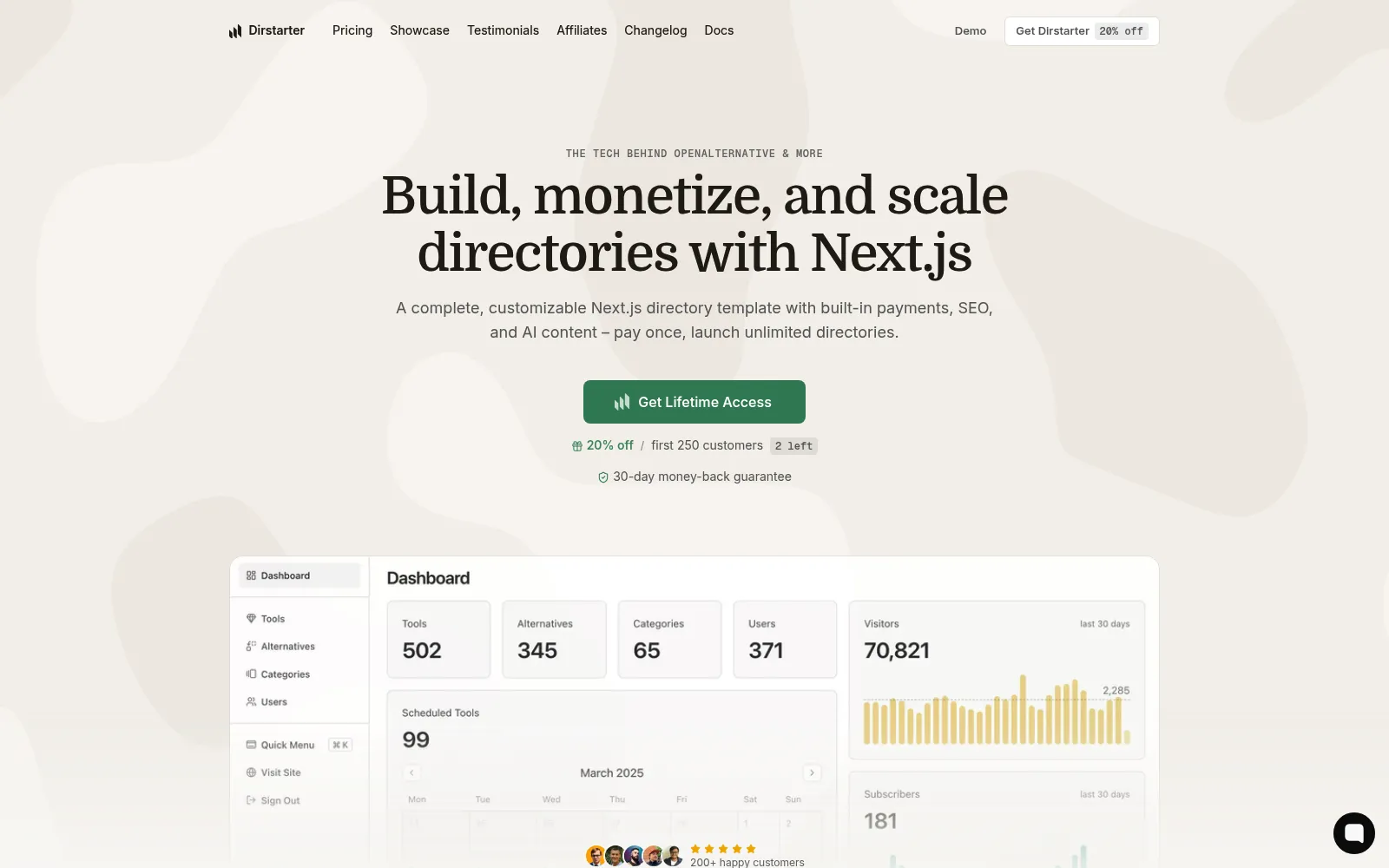
DirStarter is a modern Next.js directory boilerplate built to take you from empty repo to a live, revenue-ready directory in days rather than months. It ships on Next.js 16 with the App Router, TypeScript, Tailwind CSS, and shadcn/ui, so the codebase is one you (or any Next.js developer) will feel at home in immediately. Instead of stitching together a dozen services, you clone one repo that already has the hard parts solved.
The reason it lands at number one is coverage: Stripe payments and subscriptions, a full listing submission flow, an admin dashboard, authentication and user management, a built-in CMS and blog, internationalization, and programmatic SEO pages are all included out of the box. That means the monetization surfaces founders actually need, paid listings, featured placements, and content that ranks, are wired up on day one, not bolted on later. You seed your listings, flip on payments, and start collecting submissions.
Because you own the code outright under a one-time license, there are no per-listing fees or monthly platform tax eating your margins as you grow, and you can extend or restyle anything. For an indie hacker whose whole thesis is owning a lean, high-margin asset, DirStarter hits the sweet spot of speed, control, and completeness better than anything else on this list.
Best for:Founders and indie hackers who want to own the code and launch a fully-featured, monetizable directory in days.
Pros
Payments, submissions, admin, auth, CMS, and SEO all built in
Modern stack: Next.js 16, TypeScript, Tailwind, shadcn/ui
One-time license means no per-listing or monthly platform fees
You fully own and can customize every line of code
Cons
Requires basic Next.js and JavaScript comfort to customize
You handle your own hosting and deployment (Vercel recommended)
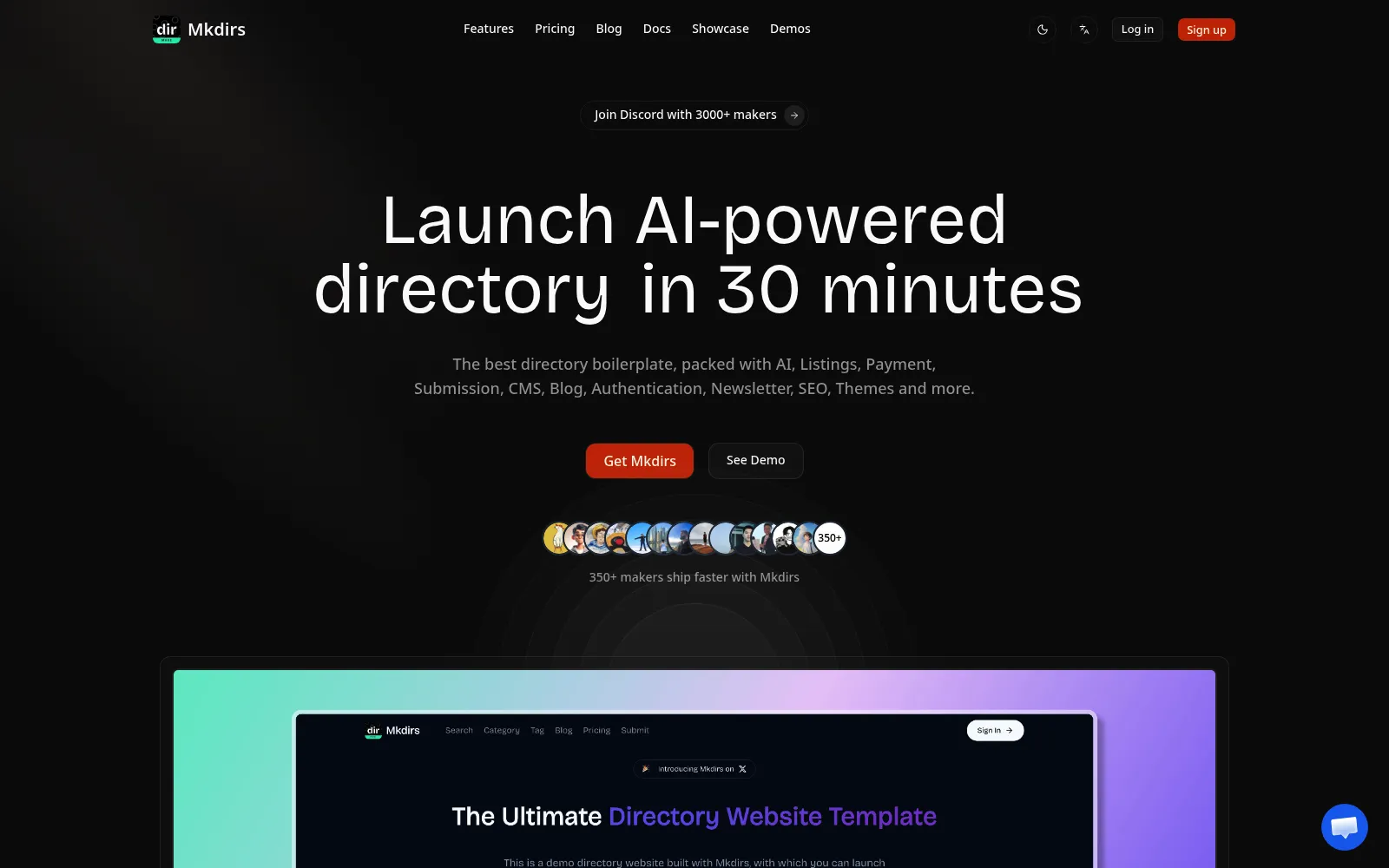
Mkdirs is one of the most popular Next.js directory boilerplates and a strong value pick. It runs on Next.js 15 with TypeScript and pairs Shadcn/UI and Tailwind CSS with Sanity Studio as the CMS, Stripe for payments and webhooks, Auth.js for authentication, and Resend for onboarding and subscription emails, giving you a genuinely out-of-the-box directory foundation.
Its standout is the workflow around content: an AI autofill feature helps populate listing details quickly, and the Sanity-backed editing experience with rich text and image uploads makes managing a growing directory painless. Combined with built-in search, filtering, a blog, and SEO, it is a well-rounded, beginner-friendly kit at a lower entry price, which is why so many launched directories run on it.
Best for:Time-constrained makers who want a widely-used, affordable Next.js boilerplate with a strong CMS and AI-assisted listings.
Pros
Low one-time price for a complete feature set
Sanity CMS with rich editing and AI autofill
Battle-tested by many live directories
Includes payments, auth, blog, search, and SEO
Cons
Still requires developer setup and Next.js knowledge
Sanity as CMS adds another service to learn
Fewer built-in enterprise/i18n extras than pricier kits
You manage hosting and third-party API keys yourself
Softr is the go-to no-code option for founders who do not want to touch code at all. It layers a drag-and-drop website builder on top of Airtable or Google Sheets, so your listings live in a familiar spreadsheet-style database while Softr renders the public directory, complete with vendor submission forms that flow straight back into Airtable and approved listings appearing automatically.
The trade-off is ownership and cost model: you are building on a hosted platform with monthly pricing rather than a codebase you keep, and deeper customization or payments rely on integrations. But for validating a niche quickly or shipping a clean directory without hiring a developer, Softr is the fastest path from idea to live site, and the free tier lets you test before paying.
Best for:Non-technical founders who want to launch and validate a directory fast without writing any code.
Pros
Truly no-code with an intuitive drag-and-drop builder
Tight Airtable and Google Sheets integration
Free tier to test plus quick setup
Built-in submission forms and gated content
Cons
Recurring monthly cost instead of one-time ownership
You do not own the underlying code or platform
Payments and advanced logic depend on integrations
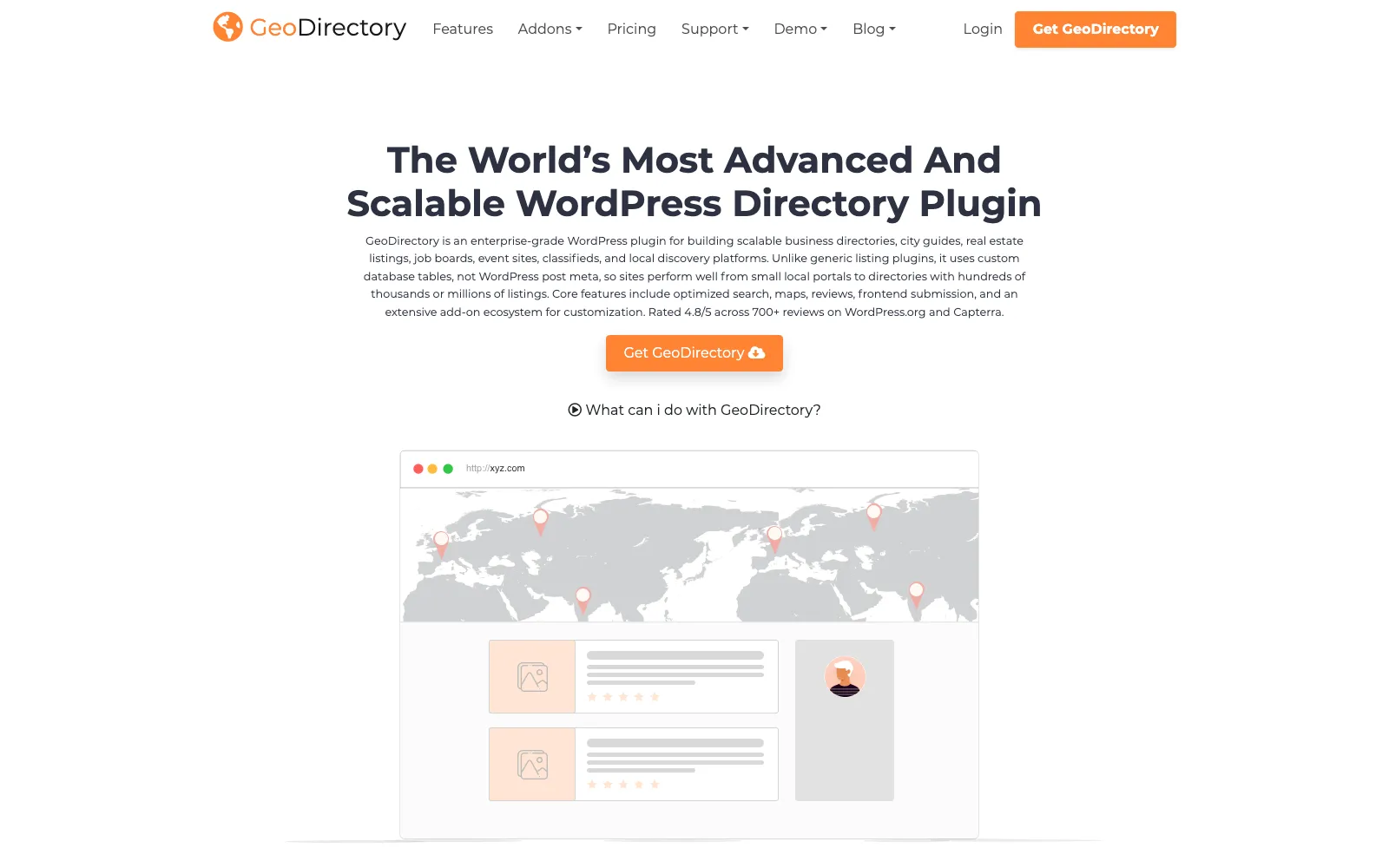
GeoDirectory is an enterprise-grade WordPress plugin for building business directories, city guides, real estate and event listings, and local discovery sites. It uses its own custom database tables for performance, and ships optimized search, maps, reviews, and frontend submission, with a Location Manager for multi-city, multi-country directories and a Pricing Manager add-on for paid listing packages.
If you already live in the WordPress ecosystem, this is the natural choice: you keep WordPress hosting and its huge plugin and theme library, and the annual membership bundles all add-ons, themes, updates, and support. It is especially strong for local and geographic directories where maps and location filtering matter, and it scales to large listing volumes thanks to those custom tables.
Best for:WordPress-based founders building local, geographic, or map-heavy directories at scale.
Pros
Built for WordPress with a massive plugin/theme ecosystem
Custom database tables handle large listing volumes
Strong maps, reviews, and location filtering
Membership bundles all add-ons, themes, and support
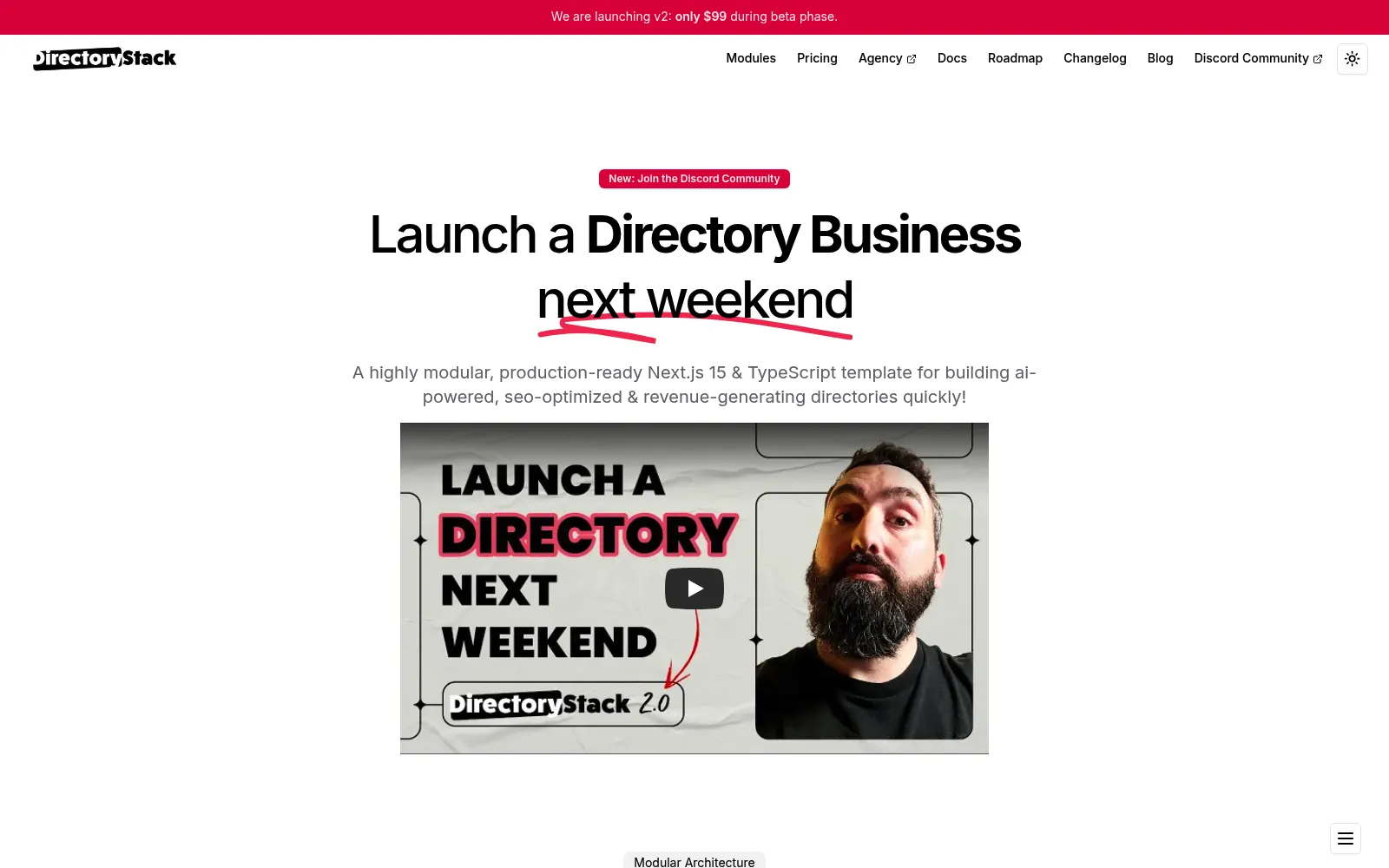
DirectoryStack is a Next.js directory boilerplate aimed at people who plan to build more than one directory. Its license permits unlimited directories with no ongoing fees, which makes it a favorite of agencies and serial founders. The stack includes Next.js, TypeScript with Zod validation, Stripe embedded forms, Vercel cron jobs, and Umami analytics, with a modular architecture you extend as each project grows.
Beyond the core listings, tags, categories, and blog, it leans into scale-oriented features like AI semantic search and an advanced KPI dashboard so you can monitor and grow a portfolio of sites. If your goal is to spin up several directories or serve clients rather than a single flagship, its unlimited one-time model and modular design are a compelling fit.
Best for:Agencies and entrepreneurs who want to launch multiple directories from one one-time, unlimited license.
Yes, directories can be very profitable because they compound. Once you have listings and traffic, you earn from paid or featured listings, display ads, sponsorships, and affiliate commissions, all against low ongoing costs. Margins are especially high when you own the code and avoid per-listing platform fees, though profitability depends on picking a niche with real demand and building an audience through SEO.
How do directories make money?+
The main revenue streams are paid and featured listings (businesses pay to be listed or to stand out), display advertising and sponsorships, affiliate links to the tools or services you list, and premium memberships or lead generation. Most successful directories combine several of these, and boilerplates like DirStarter ship the payment and featured-listing plumbing so you can monetize from launch.
Do I need to code to start a directory?+
No. If you want zero code, a no-code builder like Softr lets you launch on top of Airtable, and WordPress plugins like GeoDirectory need little to no coding. But if you want to fully own your site, keep margins high, and customize freely, a Next.js boilerplate such as DirStarter is worth basic developer comfort, and it removes the hardest engineering work for you.
How long does it take to launch a directory?+
With a modern boilerplate you can have a working directory live in days rather than months, since payments, submissions, admin, auth, and SEO are already built. No-code tools can get a basic site up in hours. The longer part is usually seeding your first listings and building the SEO content that drives traffic, so plan for a few weeks to reach a genuinely useful, ranking site.
What is the best directory boilerplate?+
For most founders in 2026, DirStarter is the best directory boilerplate: it is a modern Next.js kit with payments, submissions, an admin dashboard, CMS, auth, and programmatic SEO built in, sold under a one-time license so you own the code. Mkdirs is a strong lower-cost alternative, and DirectoryStack is ideal if you plan to run multiple directories.
The verdict
DirStarter is our top pick for starting a directory website in 2026. It combines a modern Next.js stack with everything you need to monetize, payments, submissions, admin, CMS, auth, and programmatic SEO, under a one-time license so you own the code and keep your margins. If you want no-code choose Softr, if you live in WordPress choose GeoDirectory, but for founders who want speed, control, and completeness, DirStarter is the one to build on.
We are the editorial team behind Alternative.tools, an independent platform that helps you find the best tools and their alternatives. We use AI to research and summarize newly launched websites, tools, and products, focusing on what each one does, who it's for, and which popular tools it can replace, so you can pick the right alternative faster, without the marketing spin.