Overview
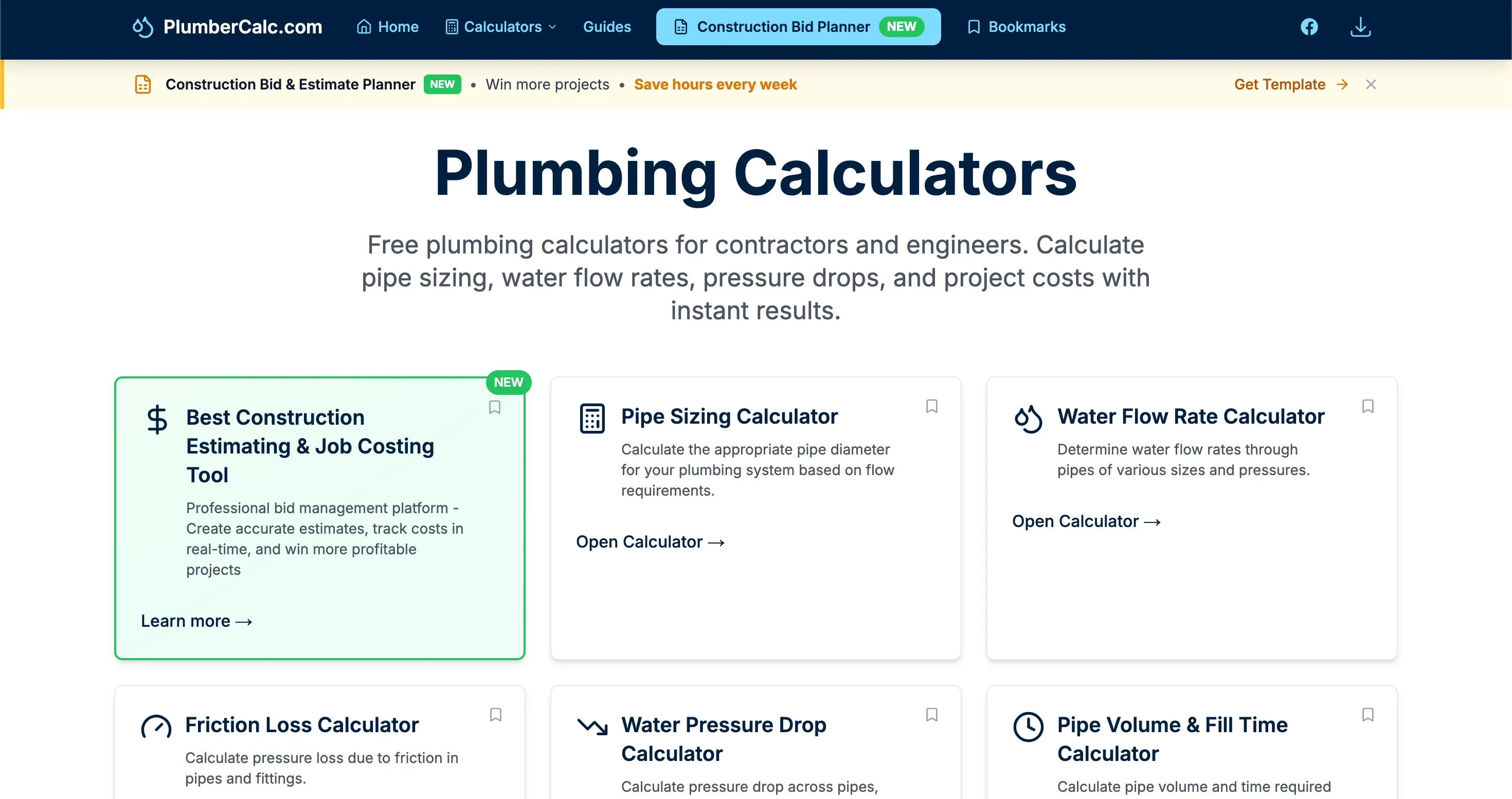
PlumberCalc is a free, web-based suite of professional plumbing calculators designed for contractors, engineers, and DIY homeowners. The platform solves a very real problem: getting accurate hydraulic and plumbing calculations without paying for expensive software or risking manual math errors. For decades, professionals had two options: shell out hundreds of dollars for specialized tools like Plumbing Calculator Pro or PipeFlow, or rely on printed tables and hand calculations that are slow and prone to mistakes. PlumberCalc sits squarely in the middle, offering over 30 industry-standard calculators that cover pipe sizing, flow rate, pressure drop, water heater sizing, gas line sizing, and much more, all at no cost and with no sign-up required.
The target audience is broad but well-defined. Plumbers in the field need quick answers on a smartphone. Mechanical engineers designing commercial systems need reliable friction loss and pressure drop numbers. Contractors preparing bids need accurate fixture unit loads and pipe sizes. Even homeowners tackling a bathroom remodel can benefit from understanding their water flow and drainage requirements. The platform is built for practical, on-the-job use, with a mobile-responsive design and offline capability that works when you are in a basement with no signal.
In the competitive landscape, PlumberCalc stands out for its breadth and accessibility. While many single-purpose calculators exist scattered across the internet, few consolidate this many tools into one cohesive, free platform. PlumberCalc is a solid alternative to Plumbing Calculator Pro, PipeFlow, and the limited calculators found on engineering toolbox sites. The inclusion of code-referenced standards like the International Plumbing Code (IPC) and ASME guidelines adds credibility that many free tools lack. This review will explore the platform's key features, usability, pricing model, and overall value to help you decide if it deserves a spot in your professional toolkit.
Key Features
- Comprehensive Calculator Library: PlumberCalc hosts over 30 specialized calculators, each targeting a specific plumbing calculation. The library includes the Pipe Sizing Calculator, Water Flow Rate Calculator, Friction Loss Calculator, Pressure Drop Calculator, Pipe Volume and Fill Time Calculator, Expansion Tank Sizing, Water Heater Sizing, Fixture Unit Load, Drainage Slope, Gas Line Sizing, Backflow Preventer Sizing, Septic System Sizing, Sump Pump Sizing, Hot Water Recirculation, Pipe Insulation Heat Loss, Tankless Water Heater Flow Rate, BTU Heating Load, Grease Trap Sizing, Water Hammer, Pump Head and Power, Glycol Calculator, Imperial/Metric Converter, HVAC Converter, Schedule 40 Pipe Sizes, Water Properties, Pipe Offset, Pipe Thermal Expansion, and DWV Pipe Sizing. This breadth means most common plumbing calculations are covered in one place, eliminating the need to bookmark dozens of different websites.
- Instant, Accurate Calculations: Each calculator uses industry-standard engineering formulas. The pipe sizing tool employs the Hazen-Williams equation for pressure flow, while the drainage slope calculator uses Manning's formula for open channel flow. Results display instantly as inputs are adjusted, providing real-time feedback that is crucial for professionals who need quick answers without manual computation errors. For example, when you change the pipe material from copper to PEX in the sizing calculator, the recommended diameter and pressure drop update immediately, allowing you to compare options side by side in seconds.
- Mobile-Ready and Offline Capability: The site is fully responsive, working seamlessly on smartphones and tablets. A standout feature is that once a page is loaded, all calculators function offline. This is a huge advantage for plumbers working in basements, crawl spaces, or remote job sites where internet access is unreliable. The site also supports installation as a Progressive Web App (PWA), allowing users to add it to their home screen for one-tap access. This offline capability is genuinely rare among free online tools and shows a deep understanding of how plumbers actually work.
- Code Compliance and Standards: The calculators are designed to align with the International Plumbing Code (IPC) and ASME guidelines. The site explicitly mentions these standards in its engineering section, giving users confidence that the results are suitable for permit applications and code compliance. However, it also advises verifying with local codes, as requirements can vary by jurisdiction. This is an honest and practical approach that professionals will appreciate, since it acknowledges the reality that local amendments often differ from national standards.
- Educational Resources and Guides: Beyond calculators, PlumberCalc offers a collection of how-to guides such as "How to Size Water Pipes" and "How to Calculate Drainage Slope," plus cost guides for pipe installation. These resources provide educational value and help users understand the underlying principles behind each calculation. For a junior engineer or an apprentice plumber, these guides serve as a valuable learning tool. The site also features a Construction Bid Planner, a newer tool for creating estimates and tracking costs, which expands its utility beyond pure calculation into project management territory.
- Bookmarking and Sharing: Users can bookmark calculators for quick access, and the site includes social sharing options. This is a small but convenient feature for professionals who frequently use specific tools. The navigation is intuitive, with calculators grouped into logical categories like "Sizing and Heating" and "Converters and References" in the footer. The homepage also lists popular calculators with brief descriptions, making it easy to find what you need without hunting through menus.
How It Works
Using PlumberCalc is refreshingly straightforward. There is no sign-up, no login, and no email verification required. Users simply navigate to the desired calculator from the homepage or the dropdown menu and start working. This frictionless approach is a major advantage for professionals who need answers fast and do not want to manage another account.
The workflow for each calculator follows a similar pattern. Take the Pipe Sizing Calculator as an example. The user enters the required flow rate in gallons per minute (GPM), selects the pipe material from a dropdown list that includes copper, PEX, PVC, and others, and inputs the pipe length in feet. The tool then recommends a pipe diameter, shows the resulting water velocity, and calculates the pressure drop across the system. This immediate feedback allows for quick iteration, such as testing different materials or flow rates to see how they affect sizing. The interface is clean and uncluttered, with clearly labeled input fields and results displayed prominently below.
For day-to-day use, the experience is designed for speed. A plumber on a job site can pull out a phone, open the site, and have an answer in under a minute. The offline capability means they do not need to worry about dead zones in basements or remote locations. The site also remembers your last used calculators through browser caching, so returning to a frequently used tool is quick.
The Construction Bid Planner is a newer addition that works slightly differently. It allows users to create estimates by adding line items for materials and labor, then calculates totals automatically. This tool is more of a project management feature than a pure calculator, and it expands the platform's utility for contractors who need to prepare bids quickly. While it does not integrate with accounting software or export to spreadsheets, it serves as a useful starting point for rough estimates.
Use Cases
- A Plumber on a Job Site: A plumber installing a new water supply line for a bathroom addition needs to determine the correct pipe size for a given flow rate and distance. Using the Pipe Sizing Calculator on a smartphone, they input the required GPM and pipe length, select copper as the material, and instantly get the recommended diameter and pressure drop. This ensures the installation meets code and performs efficiently, all without returning to the office or consulting a manual.
- A Mechanical Engineer Designing a Commercial System: An engineer designing a plumbing system for a five-story office building needs to calculate friction loss across a complex network of pipes and fittings. The Friction Loss Calculator and Pressure Drop Calculator allow them to input pipe lengths, diameters, and fitting types to obtain accurate pressure losses. This helps them select appropriate pumps and ensure adequate pressure at fixtures on the top floor, a critical factor in commercial design.
- A Homeowner Planning a Bathroom Remodel: A homeowner planning a bathroom remodel wants to ensure their new fixtures will have adequate water pressure. They use the Water Flow Rate Calculator to estimate flow rates based on pipe size and pressure, and the Fixture Unit Load Calculator to determine the total load on the system. This helps them decide whether to upgrade piping or install a pressure booster, potentially saving thousands of dollars in unnecessary renovations.
- A Contractor Preparing a Bid: A plumbing contractor needs to estimate the cost of a new installation for a competitive bid. They use the Plumbing Cost Estimator and the Construction Bid Planner to calculate material and labor costs, track expenses, and create a professional estimate. This streamlines the bidding process and helps them win more projects by providing accurate, competitive quotes quickly.
- A Facilities Manager Maintaining a Large Building: A facilities manager responsible for a 200-unit apartment building needs to size a new water heater. The Water Heater Sizing Calculator helps them determine the appropriate capacity based on the number of occupants and peak demand, ensuring hot water availability without oversizing and wasting energy. This balance between comfort and efficiency is critical for operating costs.
Design & User Experience
PlumberCalc presents a clean, modern interface that prioritizes function over flash. The design is professional and uncluttered, with a white background, clear typography, and intuitive navigation. The homepage features a grid of popular calculators with brief descriptions, making it easy to find what you need at a glance. The dropdown menu in the header provides access to the full library, organized into logical categories.
The learning curve is minimal. Each calculator presents a straightforward form with labeled input fields and a prominent results section. Users familiar with plumbing terminology will feel at home immediately. For those less experienced, the how-to guides provide step-by-step instructions that bridge the knowledge gap. The mobile experience is particularly well-executed, with touch-friendly input fields and results that are easy to read on a small screen.
One minor design criticism is that the site relies on advertising for revenue, and ads can occasionally interrupt the experience on mobile devices. However, they are not intrusive enough to detract significantly from the tool's utility. The offline capability is a standout design decision that shows a deep understanding of the target audience's working conditions. Overall, the design is functional, accessible, and well-suited to its purpose, even if it lacks the visual polish of a premium commercial product.
Pricing & Value
PlumberCalc is completely free to use. There are no subscription tiers, no premium features, and no paywalls. The site is supported by donations through a "Buy me a coffee" link and advertising. This is a significant advantage over commercial alternatives like Plumbing Calculator Pro, which can cost hundreds of dollars for a license, or engineering software like PipeFlow, which requires a subscription.
The free model makes it accessible to everyone, from DIY homeowners to large engineering firms. The lack of a paid tier means there is no feature limitation, but it also means the site relies on user support to keep running. For professionals who use it frequently, a small donation is a reasonable way to support the tool's development and ensure its long-term sustainability.
Compared to other free online calculators, PlumberCalc offers a more comprehensive and cohesive suite. While individual calculators exist on other sites, they often lack the consistency, mobile optimization, and offline capability that PlumberCalc provides. The inclusion of code references and guides adds educational value that many free tools lack. Overall, the value proposition is excellent: a professional-grade tool at no cost, with the only trade-off being the absence of advanced features like custom report generation or CAD integration.
Who Is PlumberCalc Best For?
PlumberCalc is best suited for three primary user segments. First, working plumbers and pipefitters who need quick, reliable answers on the job site. The mobile responsiveness and offline capability make it an indispensable field tool that fits in a pocket. Second, mechanical and plumbing engineers who need to verify calculations or perform quick checks without opening heavy engineering software. The adherence to industry standards and the breadth of calculators make it a valuable reference tool. Third, plumbing contractors and estimators who need to prepare bids and cost estimates efficiently. The Construction Bid Planner and cost guides streamline the estimating process.
On the other hand, users who might want to look elsewhere include those who need advanced features like custom report generation, integration with CAD software, or the ability to save and manage multiple projects within the tool. For these needs, commercial software like Plumbing Calculator Pro or full engineering suites like PipeFlow would be more appropriate. Additionally, professionals working in jurisdictions with highly specific local codes that differ significantly from IPC or ASME standards may need to supplement PlumberCalc with local reference materials.