Overview
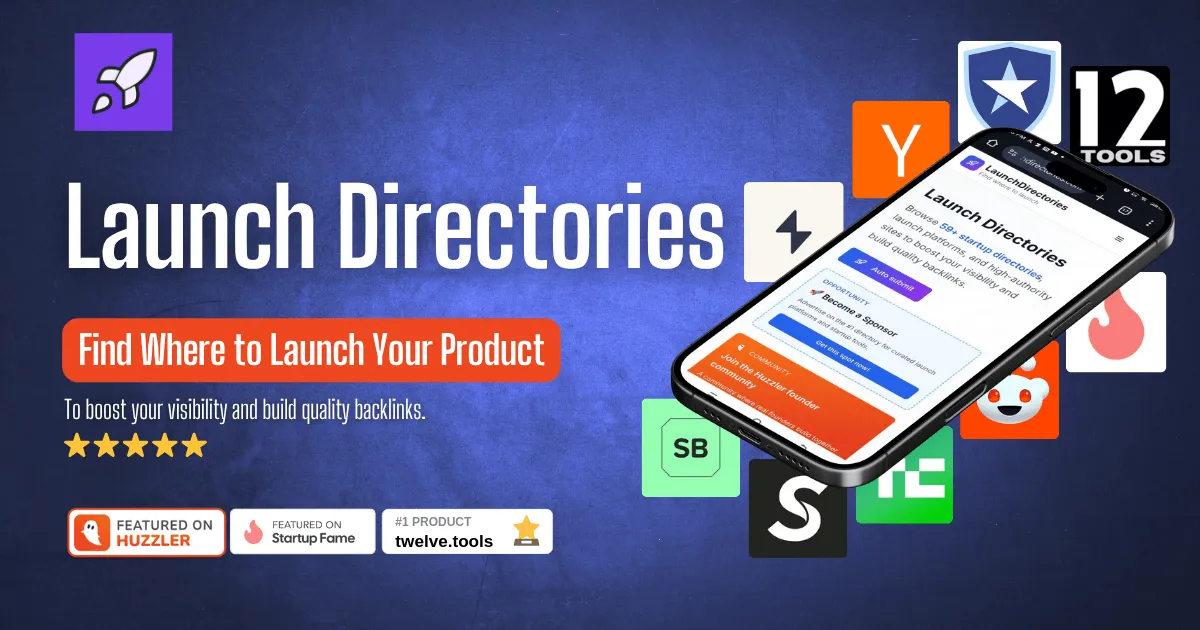
LaunchDirectories is a curated, searchable database of more than 100 startup directories, launch platforms, and high-authority websites, built to help founders decide exactly where to launch their products. The problem it solves is fragmentation. Information about which directories actually drive traffic, which ones pass SEO value through dofollow links, and which are a waste of time has traditionally been scattered across blog posts, spreadsheets, and word of mouth. LaunchDirectories pulls that data into one filterable interface.
The target audience is clear: indie hackers, early-stage SaaS founders, and growth marketers who need backlinks and visibility without spending weeks on manual research. These are people who care about Domain Rating, referral traffic, and whether a link is dofollow, but who do not have a dedicated SEO team to compile that data for them.
The competitive landscape is crowded. Static listicles go stale within months, community spreadsheets are inconsistent, and paid submission services often hide which directories they actually use. LaunchDirectories is a solid alternative to static directory listicles, community-maintained submission spreadsheets, and done-for-you services like SubmitHub-style directory blasters. It sits in the middle: a free, data-rich database on one side, and an optional paid Auto Submit service on the other.
The thesis here is simple. LaunchDirectories is not trying to be the biggest directory list. It is trying to be the most useful one, by tracking live metrics and letting founders filter down to the directories that match their specific SEO strategy.
Key Features
- Searchable and filterable directory database. The core of the product is a searchable list of 100+ directories. Users can search by name and filter by link type (dofollow or nofollow), pricing (free, freemium, paid), and other attributes. This makes it easy to narrow down to directories that match a specific strategy, such as only dofollow and free options. The value is speed: what used to take hours of cross-referencing now takes a few clicks.
- Domain Rating (DR) and traffic metrics. Every listing displays a Domain Rating from 0 to 100, which indicates the strength of the directory's backlink profile. Higher DR generally means more SEO value. The site also tracks monthly traffic stats, helping users gauge potential referral visits. According to the FAQ, these metrics are updated monthly, which keeps the data reasonably fresh compared to static blog lists.
- Dofollow vs. nofollow labeling. Each directory is clearly marked as either dofollow or nofollow. This matters because dofollow links pass link equity while nofollow links do not. The platform also indicates whether a directory requires a backlink in return, a common requirement on some listing sites. For SEO-focused founders, this single filter can save hours of wasted submissions.
- Auto Submit service. For founders who want to skip manual work, LaunchDirectories offers a done-for-you submission service. Users provide their product details once, and the team manually submits the product to 100+ directories. It is positioned as a time-saving alternative to filling out dozens of forms individually, and it is the platform's main paid offering.
- Free SEO tools and calculators. The site includes a suite of free tools such as a Domain Rating Checker, Website Authority Checker, Stripe Fee Calculator, MRR Calculator, CAC Calculator, LTV Calculator, Churn Rate Calculator, and UTM Builder. These are aimed at founders who want to measure SEO and financial metrics alongside directory submissions. They are basic compared to dedicated SEO platforms, but they are genuinely free and useful.
- Curated guides and blog content. LaunchDirectories publishes guides on topics like how to get backlinks, directory submission, local directory submission, and Reddit marketing. These resources help users understand the broader context of launch and SEO strategy, not just the directory list itself.
- Bookmarking and voting. Users can bookmark directories for later and vote on listings. The vote count appears next to each directory, giving a rough signal of community popularity. This adds a lightweight social layer to what would otherwise be a static database.
How It Works
Getting started with LaunchDirectories is straightforward, and there is no mandatory signup to browse. A visitor lands on the homepage and immediately sees a search bar and filter controls above a grid of directory cards. Each card shows the directory's logo, name, domain, a short description, DR score, link type, pricing model, and a vote count. Users can switch between a card view and a table view depending on how they prefer to scan data.
To narrow down options, users type a keyword into the search field or apply filters such as dofollow only, free only, or a specific category. Results update dynamically. Clicking a directory opens a detail page with more information, including a direct link to the submission page and any specific requirements. Users can bookmark directories to revisit later, which is handy when building a submission shortlist over several days.
For those who opt for the Auto Submit service, the workflow changes. After signing up and paying, the user submits their product details once through a form. The LaunchDirectories team then manually submits the product to the selected directories. The user does not need to create accounts on each directory or fill out individual forms. This is a hands-off solution for founders who value time over cost.
The site also offers a newsletter for updates on new directories, SEO tips, and deals. The learning curve is minimal. The interface is clean and the data is scannable, though with 100+ directories, users will need to spend some time filtering to find the best matches for their niche.
Use Cases
- A solo founder launching a B2B SaaS on a tight budget. They want maximum SEO impact for minimum spend. Using LaunchDirectories, they filter for dofollow, free directories with a DR above 50. They submit to 15 high-value sites first, then use the Auto Submit service for the rest. The result is a steady stream of backlinks without weeks of manual outreach.
- A marketing agency managing multiple client launches. The agency needs a repeatable process for building backlinks for each client. LaunchDirectories provides a centralized database they can bookmark and share with team members. The table view makes it easy to copy lists, and the DR metrics help prioritize outreach for each client's domain.
- An indie hacker preparing for a Product Hunt launch. They want to build momentum before launch day. They use LaunchDirectories to find Product Hunt alternatives and niche directories specific to their category, such as AI tools or SaaS. By submitting to 20 relevant directories in the weeks prior, they build backlinks and early traffic that can boost their Product Hunt ranking.
- A content marketer researching backlink opportunities. They are looking for high-DR sites that accept guest posts or product listings. LaunchDirectories' filters for dofollow and DR make it easy to identify targets. They can also use the free Domain Rating Checker to evaluate their own site's progress over time.
- A startup founder who wants to save time. They have more money than time. They purchase the Auto Submit service, provide their product details once, and let the LaunchDirectories team handle the rest. They receive a report of where their product was listed, which they can use for social proof.
Design & User Experience
The interface is modern and clean, with a card-based grid that keeps the focus on the data. Each directory card packs in a lot of information without feeling cluttered, and the toggle between card and table views is a smart touch for users who prefer spreadsheets. Navigation is intuitive: search and filters sit at the top, and detail pages are one click away.
The learning curve is low. There is no onboarding wizard or account requirement to browse, which lowers the barrier for casual visitors. The main rough edge is density. With 100+ listings, the homepage can feel overwhelming at first, and the site does not offer personalized recommendations based on a user's product category. Mobile responsiveness appears solid, though the table view is naturally better suited to a desktop screen. Overall, the design prioritizes function over flash, which suits the audience well.
Pricing & Value
LaunchDirectories operates on a freemium model for its directory database. Browsing the directory, using filters, and accessing the free SEO tools are all free. There is no paywall to view listings or metrics, which makes it accessible to bootstrapped founders and students.
The paid offering is the Auto Submit service, a done-for-you submission to 100+ directories. Pricing is not explicitly listed on the homepage, but a dedicated pricing page exists, so users will need to click through for exact numbers. Based on the site's positioning, the service is likely priced in the range of a few hundred dollars, comparable to other directory submission services. The value proposition is time savings: manually submitting to 100 directories could take 20 to 40 hours, so the service pays for itself if the founder's time is worth more than the cost. The free tier is generous and genuinely useful on its own, which builds trust before asking for payment.
Who Is LaunchDirectories Best For?
LaunchDirectories is best for three groups. First, indie hackers and solo founders launching a first product, who need a free, data-driven starting point for backlinks. Second, small marketing teams and agencies that want a repeatable, shareable directory list for client launches. Third, SEO-minded content marketers who need to quickly identify dofollow, high-DR targets.
It is less ideal for large enterprises with dedicated SEO teams, who likely already maintain proprietary lists and do not need a third-party database. It is also a weaker fit for founders in highly regulated or niche B2B categories, where most general directories will not be relevant. Those users might be better served by industry-specific outreach or a specialized PR service.