
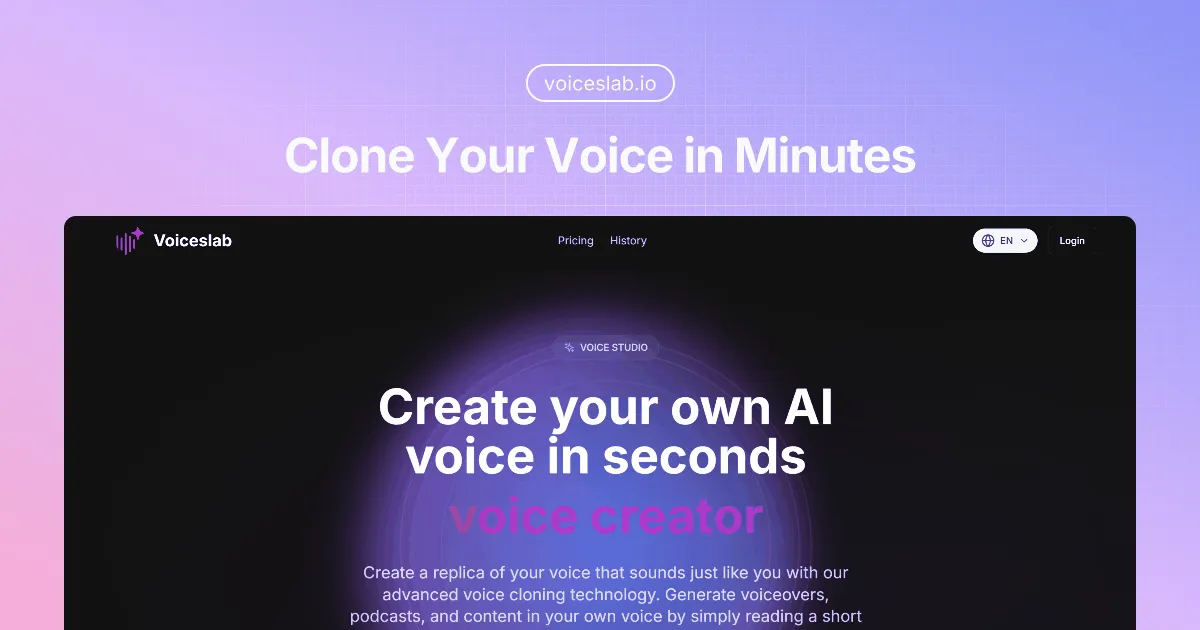
What It Is
Voiceslab is a browser-based AI voice cloning and text to speech service. A user submits a short spoken sample, and the platform builds a digital replica that can then read any new script in that same tone, accent, and rhythm. It belongs to the AI voice category alongside stock narrator libraries, but the emphasis falls on reproducing one specific person rather than choosing from a catalogue of studio actors. The free tier includes a single clone and 3,000 characters of generated speech, with no card required to start.
Key Features
-
Clone creation from a 10 to 60 second sample. The upload or record flow asks for a clean clip, then the model maps tone, accent, and pacing from it. Short input keeps setup fast, which matters for podcasters and marketers who want a usable voice the same day rather than after a week of onboarding.
-
Output across 24 languages. Speech can be produced in Arabic, Cantonese, Chinese, Czech, Dutch, English, Finnish, French, German, Greek, Hindi, Indonesian, Italian, Japanese, Korean, Polish, Portuguese, Romanian, Russian, Spanish, Thai, Turkish, Ukrainian, and Vietnamese. One recording can therefore serve international audiences without hiring localized narrators for every market.
-
No sign-up preview generator. A trial box on the homepage reads up to 500 characters in a stock voice and grants three free previews. Buyers can judge audio quality before creating an account, which removes the usual friction of evaluating voice tools through a sales call.
-
A bundled toolset beyond plain narration. Text to speech, an AI dialogue generator for multi speaker scenes, and a PDF to audio reader ship alongside the cloning engine. That combination cuts down the number of separate subscriptions a small content team has to manage.
-
Speed claims aimed at live use. The site advertises roughly half a second of latency and describes the pipeline as built for real time generation. That figure is the relevant one for interactive applications, customer support flows, and anything where a delayed render breaks the experience.
-
Security messaging for business buyers. Voice data is described as end to end encrypted, with SOC 2 compliance and daily auditing called out explicitly. This is the vocabulary procurement and legal teams scan for before approving a vendor that stores biometric data.
Best For
-
Podcasters and audiobook narrators who want to patch intro and outro segments, correct a misread line, or extend an existing series without booking studio hours for every edit.
-
Marketing and content teams producing video ads, product updates, or localized social clips. The 24 language roster means a single brand voice can carry across markets without re-recording per region.
-
Companies standardizing internal communications, particularly training videos and executive messages, where a consistent speaker voice matters more than a fresh performance every time.
How It Compares
Most text to speech products sell access to a fixed narrator library and charge per character from the first word. Voiceslab inverts that by putting cloning first and wrapping the clone in adjacent tools. Pricing follows a freemium shape: one clone and 3,000 characters free, with paid plans adding more clones and larger character allowances. The differentiators at the entry level are language reach across 24 supported languages plus explicit latency and compliance claims, which are typically reserved for higher tiers elsewhere. Teams that only need a generic narrator may find a simpler generator sufficient, while anyone who needs a specific person's voice has a narrower set of credible options.