Overview
The Audio Stuff is an independent online publication dedicated to honest, reference-anchored reviews of audiophile and hi-fi gear. Founded by Jakub Charkiewicz, the site covers headphones, speakers, DACs, amplifiers, and audio sources, with a clear editorial promise: no sponsored verdicts, long listening periods, and a scoring system anchored to a published reference list. In a market crowded with affiliate-driven reviews and first-impression takes, The Audio Stuff positions itself as a trustworthy source for consumers who want to make informed purchasing decisions based on rigorous, comparative testing.
The site currently hosts 68 reviews, each scored on a 0 to 10 scale and mapped to verdicts like Reference, Highly Recommended, Recommended, or Mixed. What sets it apart is its methodology: every piece of gear is compared head-to-head against a fixed reference chain, and scores are built from five weighted axes (tonality, technicalities, build, system fit, and value). This approach aims to make scores comparable across categories, so a 9.0 on a headphone carries the same weight as a 9.0 on a DAC. The site also offers buying guides, head-to-head comparisons, and a suite of free browser-based tools, making it a comprehensive resource for both newcomers and seasoned audiophiles.
The target audience is anyone about to spend real money on audio gear, from first-time buyers looking for budget headphones to veterans upgrading to flagship DACs. The problem it solves is simple: the audiophile review space is full of conflicting opinions, paid placements, and hype-driven takes. The Audio Stuff is a solid alternative to Head-Fi, Darko.Audio, and What Hi-Fi, offering a more methodical and transparent approach to gear evaluation. For anyone tired of wondering whether a glowing review was influenced by an affiliate commission, this site offers a refreshing dose of rigor.
Key Features
- Reference-Anchored Scoring System: Every review is scored against a published reference list per category. The scoring rubric is transparent, with five weighted axes: tonality (30%), technicalities (25%), build and ergonomics (15%), system fit (15%), and value (15%). This ensures that scores are consistent and meaningful across different product types. For example, the HIFIMAN HE1000se earned a 9.3 Reference score, while the Douk Audio U2 Pro received a 6.5 Mixed verdict, reflecting real comparative differences. This system matters because it lets readers compare a DAC score to a headphone score with confidence, knowing the same standards were applied.
- No Sponsored Verdicts: The site explicitly states that brands have zero editorial input and that pre-publication review is never granted. This independence is a core selling point, and the site even discloses if a manufacturer pulls advertising over a negative review. This builds trust with readers who are tired of biased reviews. In practice, this means you can read a critical take on a popular product without wondering if the reviewer was pressured to soften the verdict. The site's About page outlines this policy clearly, and the stats bar on the homepage proudly displays "zero sponsored verdicts."
- Long Listening Periods: Each review involves a minimum of two weeks of real-world use, often four to eight weeks for flagship gear. The site avoids first-impression reviews and demo-room verdicts, ensuring that scores reflect sustained listening across multiple sources and genres. This is a significant commitment to thoroughness. A reviewer might spend a month with a pair of planar magnetic headphones, testing them with solid-state and tube amps, different DACs, and a variety of music genres before assigning a score. This depth of testing is rare in an industry where many reviews are published within days of a product's launch.
- Comprehensive Buying Guides: The site offers 11 curated "best of" lists, such as Best Budget Headphones, Best DACs, and Best Open-Back Headphones. Each guide includes only scored reviews, ranked by actual performance, not by who paid. This saves readers time by providing a shortlist of proven products. For example, the Best Budget Headphones guide lists 8 scored picks, with the Kiwi Ears Belle, Cadenza II, Orchestra II as the top pick at 8.1. These guides are updated as new reviews are published, so they stay current.
- Head-to-Head Comparisons: With 37 comparisons, the site allows readers to see how closely matched products stack up. For example, the HIFIMAN Arya Organic vs. HE1000se comparison shows a 0.1 point gap, helping readers understand subtle differences. These comparisons are based on the same chain and listening protocol, making them reliable. This feature is particularly useful for buyers deciding between two similar products in the same price range, as it highlights specific strengths and weaknesses rather than just overall scores.
- Free Audio Tools: The site includes 16 browser-based tools, such as a Headphone Power Calculator, ABX Blind Test, FLAC & Hi-Res Checker, and Room Modes visualizer. These tools are practical for audiophiles and require no signup or tracking, adding value beyond reviews. The Headphone Power Calculator, for instance, helps users check if their current amp can drive a new pair of headphones, while the ABX Blind Test lets users test their own listening abilities. These tools are genuinely useful and free, which is rare in the audio space.
- Transparent Methodology and Standards: The site cites independent standards like ITU-R BS.1116 for listening tests, AES standards for measurements, and the Harman Target Curve for headphone tonality. This grounding in established research lends credibility to the reviews. The methodology page explains exactly how the reference chain is configured, what gear is used, and how scores are calculated. This level of transparency is almost unheard of in consumer audio reviews, where methodology is often vague or undisclosed.
How It Works
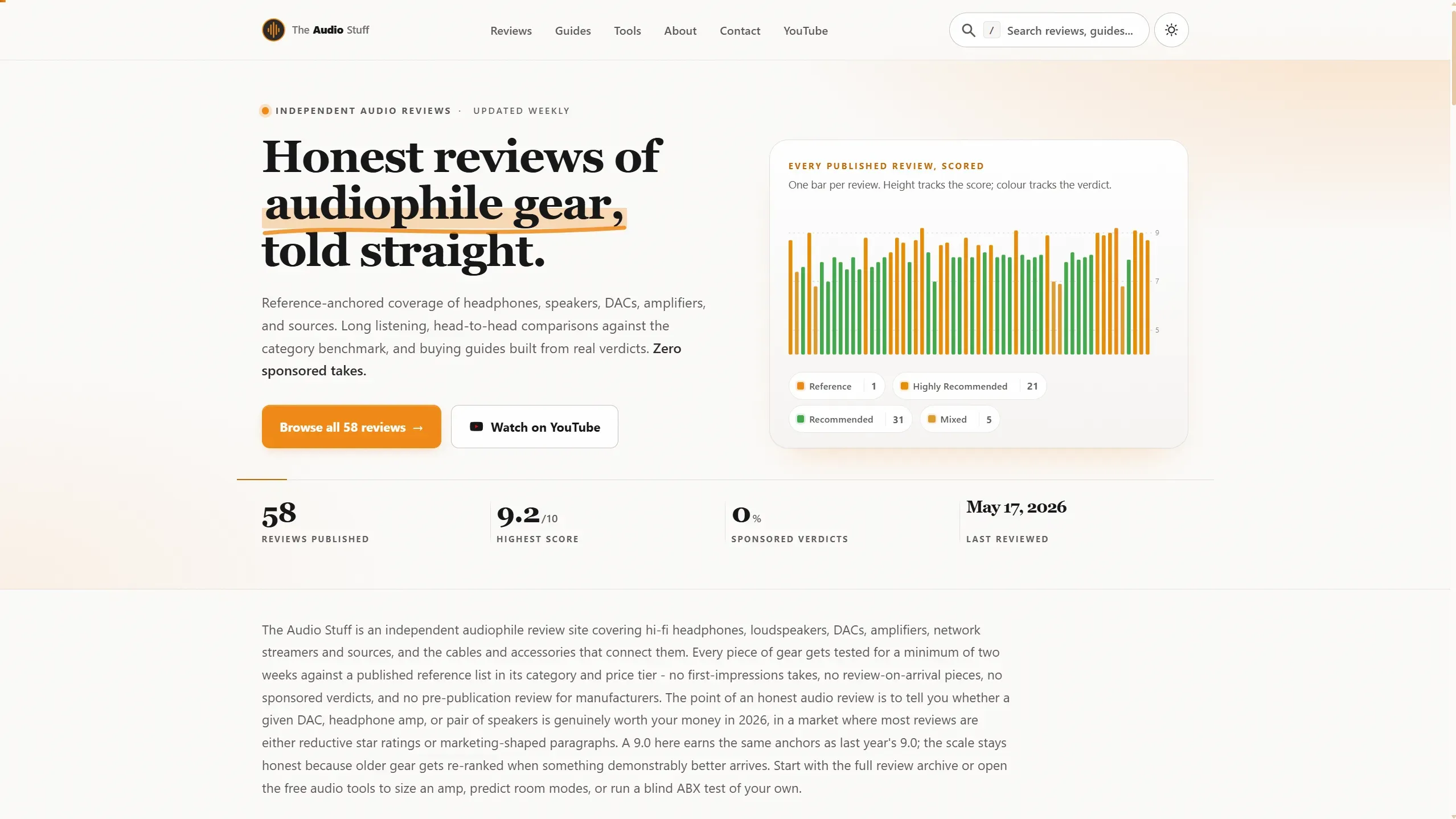
Visitors to The Audio Stuff land on a clean, modern homepage that immediately communicates the site's mission: "Honest reviews of audiophile gear, told straight." The hero section displays a chart of recent verdicts, with scores and verdict tiers, and a stats bar showing 68 reviews published, a highest score of 9.3, and zero sponsored verdicts. From there, users can browse reviews by category (Headphones, Speakers, DACs, etc.) or explore guides, comparisons, and tools.
For a typical user researching a new pair of headphones, the journey might start with the reviews section, where they can filter by verdict tier or category. Each review page includes a detailed analysis, pros and cons, a score, and a verdict stamp. The site also provides a buying guide for quick recommendations, and a comparison tool for head-to-head matchups. The free tools, like the Headphone Power Calculator, help users check if their current amp can drive a new pair of headphones.
The site is designed to be accessible, with a search function, a glossary, and an FAQ section. The editorial standards are clearly outlined on the About page, which explains the scoring rubric and the reference chain. Overall, the user experience is straightforward: find a product, read the review, and make an informed decision. There is no signup required for any of the content or tools, which lowers the barrier to entry. The site also has a YouTube channel where video reviews complement the written content, though the written reviews remain the core offering.
Use Cases
- A first-time buyer looking for budget headphones: A user with a $100 budget can visit the Best Budget Headphones guide and see 8 scored picks, with the Kiwi Ears Belle, Cadenza II, Orchestra II as the top pick at 8.1. The guide provides a shortlist, saving hours of research. The user can then read the full review, check the power calculator to see if their phone can drive them, and make a confident purchase.
- An audiophile upgrading to a flagship DAC: Someone considering a high-end DAC can read the review of the Denafrips Enyo 15th Anniversary (9.1/10) and compare it with other DACs in the Best DACs guide. The reference-anchored scoring helps them understand how it stacks up against alternatives. They can also use the comparison tool to see how it fares against a cheaper option, helping them decide if the extra cost is justified.
- A home theater enthusiast setting up a room: The Room Modes tool helps visualize standing waves and suggests bass trap placement. This is useful for anyone setting up speakers in a new room, and the site's speaker reviews, like the Triangle Australe EZ (8.1/10), provide real-world performance data. The user can read the review, check the room modes tool, and position their speakers optimally.
- A content creator needing a microphone: The FIFINE K688 review (7.2/10) covers a dynamic mic with built-in interface, ideal for podcasters or streamers. The review includes price, performance, and a verdict, helping creators choose gear that fits their budget. The user can also check the ABX Blind Test tool to test their own listening skills, which is useful for audio editing work.
- A network audio enthusiast: The Synergistic Research Network Router UEF review (7.8/10) explores whether a $3,000 router improves sound quality. This is a niche but growing interest, and the site's honest assessment helps readers decide if such an investment is worth it. The review includes measurements and listening impressions, giving readers a clear picture of what they are paying for.
Design & User Experience
The Audio Stuff has a clean, modern design that prioritizes readability and navigation. The homepage features a hero section with a chart of recent verdicts, a stats bar, and clear calls to action for reviews, guides, and tools. The color scheme is muted and professional, with accent colors used sparingly to highlight key information like scores and verdicts. The typography is legible, and the layout is well-structured, making it easy to skim reviews and find relevant sections.
Navigation is intuitive, with a top menu bar that categorizes content into Reviews, Guides, Comparisons, Tools, and About. Each category page has filters for verdict tier and product type, which is helpful for narrowing down options. The search function works well, and the glossary is a nice touch for newcomers who might not know terms like "planar magnetic" or "chi-fi." The site is fully responsive, and the mobile experience is solid, with no noticeable layout issues on smaller screens.
The learning curve is minimal. Anyone who has read a product review online will feel at home immediately. The main potential improvement is the relatively small number of reviews, which means some categories have sparse coverage. However, the quality of the content more than compensates for the quantity. The design choices, such as the verdict stamps and score breakdowns, make the site feel authoritative without being stuffy.
Pricing & Value
The Audio Stuff is completely free to access. There is no paywall, no subscription tier, and no premium content. All 68 reviews, 11 buying guides, 37 comparisons, and 16 tools are available to anyone who visits the site. The site generates revenue through affiliate links and YouTube ads, but it explicitly states that this does not influence verdicts. This is a significant advantage over competitors that may offer free content but with more obvious commercial bias.
For readers, the value is in the time saved and the confidence gained from reliable reviews. Compared to other review sites that may accept sponsored content, The Audio Stuff's independence is a significant advantage. The free tools add further value, as similar calculators or analyzers often cost money or require installation. While the site doesn't sell products directly, its recommendations can lead to significant savings by helping readers avoid poor purchases. The lack of a paid tier is a deliberate choice, and it makes the site accessible to everyone, from casual listeners to hardcore audiophiles.
Who Is The Audio Stuff Best For?
The Audio Stuff is best for three main groups. First, first-time buyers who are overwhelmed by the sheer number of options and conflicting reviews. The buying guides and reference-anchored scoring give them a clear starting point, and the free tools help them make practical decisions, like whether their phone can drive a particular pair of headphones. Second, experienced audiophiles who are tired of hype-driven reviews and want methodical, comparative testing. The reference chain and transparent methodology give them confidence that scores are meaningful. Third, anyone making a significant purchase, like a $2,000 DAC or a $3,000 pair of speakers, who wants to minimize the risk of buyer's remorse.
On the other hand, the site might not be ideal for people who want video-first content, as the written reviews are the core offering. It also may not satisfy those looking for coverage of every new product on the market, given the relatively small number of reviews. For those users, a site like Head-Fi with its massive forum community might be a better fit. Additionally, people who prefer subjective, impressionistic reviews over data-driven analysis might find the site too clinical.