
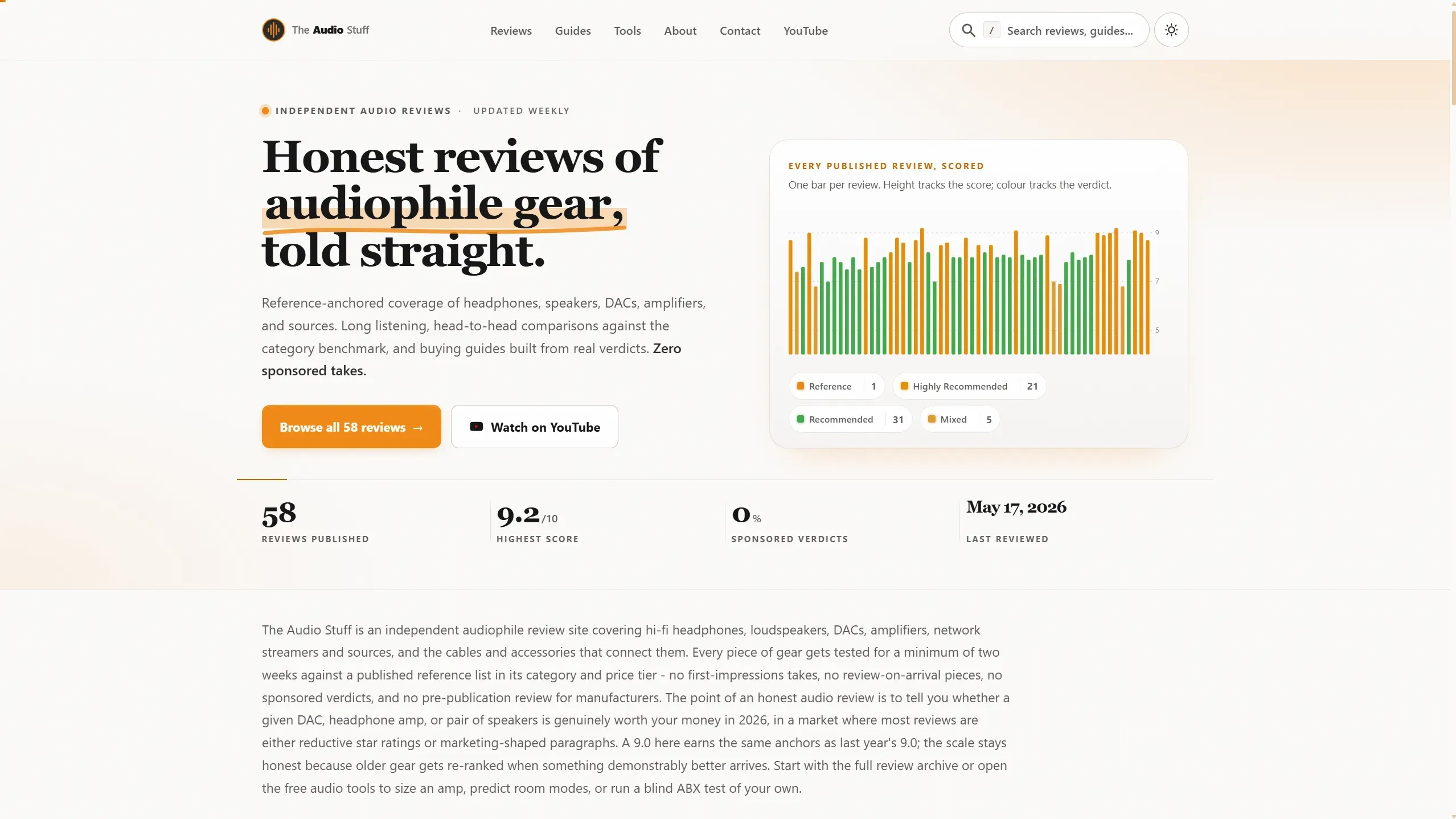
Overview
The Audio Stuff is an independent online publication dedicated to honest, reference-anchored reviews of audiophile and hi-fi gear. Founded by Jakub Charkiewicz, the site covers headphones, speakers, DACs, amplifiers, and audio sources, with a clear editorial promise: no sponsored verdicts, long listening periods, and a scoring system anchored to a published reference list. In a market crowded with affiliate-driven reviews and first-impression takes, The Audio Stuff positions itself as a trustworthy source for consumers who want to make informed purchasing decisions based on rigorous, comparative testing.
The site currently hosts 68 reviews, each scored on a 0 to 10 scale and mapped to verdicts like Reference, Highly Recommended, Recommended, or Mixed. What sets it apart is its methodology: every piece of gear is compared head-to-head against a fixed reference chain, and scores are built from five weighted axes (tonality, technicalities, build, system fit, and value). This approach aims to make scores comparable across categories, so a 9.0 on a headphone carries the same weight as a 9.0 on a DAC. The site also offers buying guides, head-to-head comparisons, and a suite of free browser-based tools, making it a comprehensive resource for both newcomers and seasoned audiophiles.
Key Features
-
Reference-Anchored Scoring System: Every review is scored against a published reference list per category. The scoring rubric is transparent, with five weighted axes: tonality (30%), technicalities (25%), build and ergonomics (15%), system fit (15%), and value (15%). This ensures that scores are consistent and meaningful across different product types. For example, the HIFIMAN HE1000se earned a 9.3 Reference score, while the Douk Audio U2 Pro received a 6.5 Mixed verdict, reflecting real comparative differences.
-
No Sponsored Verdicts: The site explicitly states that brands have zero editorial input and that pre-publication review is never granted. This independence is a core selling point, and the site even discloses if a manufacturer pulls advertising over a negative review. This builds trust with readers who are tired of biased reviews.
-
Long Listening Periods: Each review involves a minimum of two weeks of real-world use, often four to eight weeks for flagship gear. The site avoids first-impression reviews and demo-room verdicts, ensuring that scores reflect sustained listening across multiple sources and genres. This is a significant commitment to thoroughness.
-
Comprehensive Buying Guides: The site offers 11 curated "best of" lists, such as Best Budget Headphones, Best DACs, and Best Open-Back Headphones. Each guide includes only scored reviews, ranked by actual performance, not by who paid. This saves readers time by providing a shortlist of proven products.
-
Head-to-Head Comparisons: With 37 comparisons, the site allows readers to see how closely matched products stack up. For example, the HIFIMAN Arya Organic vs. HE1000se comparison shows a 0.1 point gap, helping readers understand subtle differences. These comparisons are based on the same chain and listening protocol, making them reliable.
-
Free Audio Tools: The site includes 16 browser-based tools, such as a Headphone Power Calculator, ABX Blind Test, FLAC & Hi-Res Checker, and Room Modes visualizer. These tools are practical for audiophiles and require no signup or tracking, adding value beyond reviews.
-
Transparent Methodology and Standards: The site cites independent standards like ITU-R BS.1116 for listening tests, AES standards for measurements, and the Harman Target Curve for headphone tonality. This grounding in established research lends credibility to the reviews.
How It Works
Visitors to The Audio Stuff land on a clean, modern homepage that immediately communicates the site's mission: "Honest reviews of audiophile gear, told straight." The hero section displays a chart of recent verdicts, with scores and verdict tiers, and a stats bar showing 68 reviews published, a highest score of 9.3, and zero sponsored verdicts. From there, users can browse reviews by category (Headphones, Speakers, DACs, etc.) or explore guides, comparisons, and tools.
For a typical user researching a new pair of headphones, the journey might start with the reviews section, where they can filter by verdict tier or category. Each review page includes a detailed analysis, pros and cons, a score, and a verdict stamp. The site also provides a buying guide for quick recommendations, and a comparison tool for head-to-head matchups. The free tools, like the Headphone Power Calculator, help users check if their current amp can drive a new pair of headphones.
The site is designed to be accessible, with a search function, a glossary, and an FAQ section. The editorial standards are clearly outlined on the About page, which explains the scoring rubric and the reference chain. Overall, the user experience is straightforward: find a product, read the review, and make an informed decision.
Use Cases
-
A first-time buyer looking for budget headphones: A user with a $100 budget can visit the Best Budget Headphones guide and see 8 scored picks, with the Kiwi Ears Belle, Cadenza II, Orchestra II as the top pick at 8.1. The guide provides a shortlist, saving hours of research.
-
An audiophile upgrading to a flagship DAC: Someone considering a high-end DAC can read the review of the Denafrips Enyo 15th Anniversary (9.1/10) and compare it with other DACs in the Best DACs guide. The reference-anchored scoring helps them understand how it stacks up against alternatives.
-
A home theater enthusiast setting up a room: The Room Modes tool helps visualize standing waves and suggests bass trap placement. This is useful for anyone setting up speakers in a new room, and the site's speaker reviews, like the Triangle Australe EZ (8.1/10), provide real-world performance data.
-
A content creator needing a microphone: The FIFINE K688 review (7.2/10) covers a dynamic mic with built-in interface, ideal for podcasters or streamers. The review includes price, performance, and a verdict, helping creators choose gear that fits their budget.
-
A network audio enthusiast: The Synergistic Research Network Router UEF review (7.8/10) explores whether a $3,000 router improves sound quality. This is a niche but growing interest, and the site's honest assessment helps readers decide if such an investment is worth it.
Pricing & Value
The Audio Stuff itself is free to access, with no paywall or subscription. The site generates revenue presumably through affiliate links and YouTube ads, but it explicitly states that this does not influence verdicts. For readers, the value is in the time saved and the confidence gained from reliable reviews. Compared to other review sites that may accept sponsored content, The Audio Stuff's independence is a significant advantage. The free tools add further value, as similar calculators or analyzers often cost money or require installation. While the site doesn't sell products directly, its recommendations can lead to significant savings by helping readers avoid poor purchases.
Final Verdict
The Audio Stuff stands out as a trustworthy, methodical resource in the audiophile review space. Its commitment to no sponsored verdicts, long listening periods, and reference-anchored scoring sets a high standard. The site's comprehensive guides, comparisons, and free tools make it a one-stop shop for audio enthusiasts. The main limitation is the relatively small number of reviews (68), which may not cover every product a reader is interested in, but the quality over quantity approach is a strength. For anyone serious about hi-fi gear, The Audio Stuff is an essential bookmark. It's particularly valuable for those who want to avoid marketing hype and make decisions based on rigorous testing. While it may not have the sheer volume of some larger sites, its integrity and depth make it a go-to source.