6 Best VPS Hosting Providers for 2026, Compared and Rated
6 Best VPS Hosting Providers for 2026, Compared and Rated
We compared six VPS providers on what a dollar actually buys, read every price from the vendor's own page on Black Friday 2026, and rated each one. Hetzner for value in Europe, DigitalOcean for the ecosystem, Vultr for reach, Akamai for predictability, Hostinger for beginners, Contabo for raw resources.
The best price to performance ratio in this list: CPX02 gives you 1 AMD vCPU, 1 GB of RAM and 20 GB of NVMe for €5.49 a month before VAT, and CPX22 gives you 2 vCPUs, 4 GB and 80 GB for €16.99
20 TB of included traffic on every European plan, which is twenty times what DigitalOcean bundles at a similar price
Dedicated vCPU plans start at €36.99 for 2 cores and 8 GB (CCX13 in Helsinki), with the same 20 TB allowance
Alternative.tools review team
Editorial team
We are the editorial team behind Alternative.tools, an independent platform that helps you find the best tools and their alternatives. We use AI to research and summarize newly launched websites, tools, and products, focusing on what each one does, who it's for, and which popular tools it can replace, so you can pick the right alternative faster, without the marketing spin.
Hourly billing capped at the monthly price, free stateful firewalls, private networks, a REST API, a CLI and official Terraform and Ansible integrations
One click apps for Coolify, Docker, Nextcloud, GitLab, WordPress and WireGuard, so a self hosted stack is a few minutes of work
Data centres in Germany and Finland are ISO 27001 certified, the company is GDPR native, and the SLA promises 99.9% uptime with 24/7 email support
Cons
Only four regions plus Singapore: Falkenstein, Nuremberg, Helsinki, Ashburn and Hillsboro, so Asia Pacific and South America are poorly served
US and Singapore servers include 1 TB of traffic rather than 20 TB, and Singapore prices run higher (CPX02 is €7.99 there)
The Cost-Optimized line (CX23 at €5.99 for 2 vCPUs and 4 GB, and the Arm based CAX11 at €6.49) was marked not available on the day we checked, which happens often enough to plan around
German data centres cost a little more than Finnish ones for the same plan (CCX13 is €36.99 in Helsinki and €43.49 in Nuremberg)
Support is email only, no phone, no chat
Why we picked Hetzner
Hetzner wins on the one thing most people are buying a VPS for: the most machine for the least money, from a company that has been doing this since the 1990s. The CPX line runs on AMD EPYC hardware with NVMe storage, and the allowance of 20 TB of traffic a month in Europe means bandwidth simply stops being a line item for almost everyone.
The catch is geography and availability. If your users are in Europe or the US east coast, Hetzner is close to unbeatable. If they are in Sydney, Mumbai or São Paulo, it is not an option, and if you specifically want the cheapest Cost-Optimized plans you may find them out of stock, as we did. Keep the Regular Performance CPX plans in mind as the fallback, since those were available everywhere.
One more practical note: prices on hetzner.com are shown with your VAT rate applied, and the site asks for your location on first visit. The figures above are before VAT, which is how Hetzner presents them to business customers and how its price API returns them.
Who it is for: anyone in Europe or the US who wants the best value VPS and is happy to manage it themselves. Pricing is at hetzner.com/cloud.
What makes DigitalOcean the best VPS for documentation and add-ons?
Pros
The clearest pricing page in the category: Basic Droplets from $4 (512 MiB), $6 (1 GiB), $12 (2 GiB), $24 (2 vCPUs, 4 GiB) and $48 (4 vCPUs, 8 GiB), with the hourly rate printed next to every monthly one
Per second billing since January 1, 2026, with a 60 second minimum, so a test box that lives for ten minutes costs cents
Premium Droplets with NVMe and newer AMD or Intel CPUs start at $7 and $8 for 1 GiB, and dedicated CPU-Optimized Droplets start at $42
The deepest tutorial library of any host, which is why the error message you paste into a search engine usually leads back here
A full platform around the VPS: managed Postgres, MySQL, Valkey and Kafka, Spaces object storage, load balancers, Kubernetes, App Platform and a marketplace of one click images
Mature API, Terraform provider and CLI, and monthly billing caps that make bills predictable
Cons
You pay for the ecosystem: $6 buys 1 GiB of RAM and 25 GiB of disk, where Hetzner's €5.49 buys the same RAM with NVMe and 20 TB of traffic, and Hostinger's $6.49 buys 4 GB
Bundled transfer is modest, 500 GiB on the $4 plan and 1,000 GiB on the $6 plan, and overage is billed per GiB
The 512 MiB Droplet is too small for most real workloads, so the practical entry price is $6
Backups, snapshots and reserved IPs are all paid extras
Why we picked DigitalOcean
If Hetzner is the engineer's choice, DigitalOcean is the one you can hand to a junior developer and expect to work. The console is uncluttered, every product has a tutorial that walks through the setup, and the pricing is the most legible in the industry. Per second billing, which arrived in January 2026, removes the last reason to think twice before spinning up a throwaway machine.
The weak point is how much Droplet you get per dollar. At the $6 tier you are buying a 1 GiB machine with a 1,000 GiB transfer cap, and the NVMe Premium variants cost a dollar or two more again. That premium buys you managed databases a click away and documentation that saves hours, which for a lot of small teams is worth more than an extra gigabyte of RAM.
Watch the direction of travel, though. DigitalOcean spent 2026 launching GPU Droplets, an inference engine and managed agents, and the Droplet product that made its name is now one line in a long menu.
Who it is for: small teams and solo developers who value documentation and managed services over the last few percent of price. Pricing is at digitalocean.com/pricing/droplets.
What makes Vultr the best VPS for the cheapest entry point?
Pros
The cheapest plan in this roundup: $2.50 a month for 1 vCPU, 512 MB of RAM, 10 GB of SSD and 0.5 TB of transfer, or $3.50 if you need an IPv4 address
Three shared tiers to choose from at the same price points: Regular Performance ($5 for 1 GB), High Frequency on 3 GHz+ Intel with NVMe ($6 for 1 GB and 32 GB of NVMe) and High Performance on current AMD or Intel with NVMe ($6 for 1 GB with 2 TB of transfer)
Hourly billing with monthly caps, and the hourly figure is printed on the pricing page beside every plan
Bare metal, dedicated Optimized Cloud Compute and the new VX1 line, which Vultr says offers up to 82% better performance per dollar than hyperscaler equivalents, all under one account
Block storage, object storage, Kubernetes, load balancers, managed databases and a marketplace of images, so it scales with you
A long list of locations across every continent, which matters if your users are not in Europe or North America
Cons
The $2.50 and $5 Regular Performance plans run on previous generation Intel CPUs and ordinary SSD, so the price that gets you in the door is not the price of the machine you want
Transfer is thinner than Hetzner at every tier: 1 TB on the $5 plan, 2 TB on the $6 High Performance plan
The homepage was behind a bot verification wall and two separate consent dialogs when we visited, which is a small thing that says something about the experience
Why we picked Vultr
Vultr earns its place by covering the whole range. Nobody else here will sell you a $2.50 IPv6 only box for a cron job and a bare metal server for a database on the same invoice, and nobody else gives you three distinct shared CPU tiers at every size so you can pay exactly for the generation of hardware you need.
The honest reading of the pricing page is that the Regular Performance line exists to be cheap and the High Frequency and High Performance lines exist to be good. The $6 High Performance plan, with 1 GB of RAM, 25 GB of NVMe and 2 TB of transfer, is the one to compare against DigitalOcean's $6 and $7 Droplets, and it compares well.
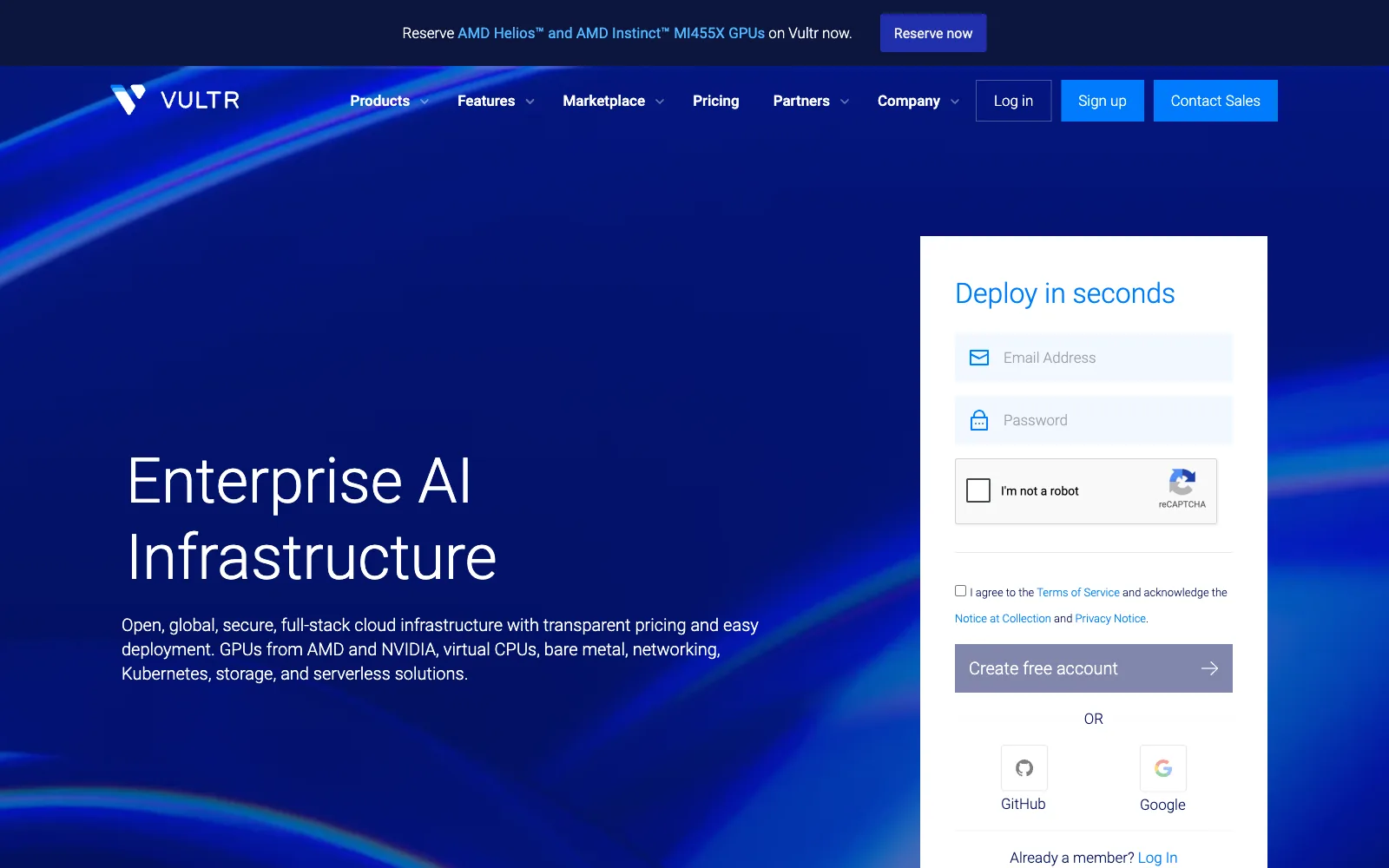
Like DigitalOcean, Vultr has pointed its marketing at AI. The homepage headline is Enterprise AI Infrastructure and the banner is about reserving AMD GPUs. The VPS business underneath it is intact, and the pricing is still among the clearest, but you have to go looking for it.
Who it is for: developers who want the lowest possible entry price, need a location outside Europe and the US, or want to grow from a $6 VPS into dedicated or bare metal without changing vendors. Pricing is at vultr.com/pricing.
What makes Akamai Cloud the best VPS for predictable bills?
Pros
Simple, stable shared plans: Nanode 1 GB for $5 (1 vCPU, 25 GB, 1 TB transfer), Linode 2 GB for $12, 4 GB with 2 vCPUs for $24, 8 GB with 4 vCPUs for $48, each with the hourly rate alongside
Transfer allowances are pooled across every instance on your account, and overage is a flat $0.005 per GB, which Akamai says is the lowest in the market
Hourly billing capped at the monthly price, with the rule spelled out in the FAQ: a 1 GB VM deleted after 24 hours costs $0.18
24/7/365 email and phone support for every customer, including the $5 one, which no other provider in this list offers
Dedicated CPU, High Memory and the new G8 generation on 5th Gen AMD EPYC, plus managed Kubernetes with no per cluster fee, managed MySQL, PostgreSQL and Valkey, and block and object storage
Akamai says it offers 25 or more core compute regions, and the Akamai edge network sits behind the platform for CDN and DDoS protection
Cons
The brand transition is still visible: linode.com/pricing redirects to akamai.com/cloud/pricing, the console is still called Cloud Manager, and the plans are still named Linode and Nanode
The G8 Dedicated plans bundle 0 TB of transfer, a clear break from the generous allowances the shared plans are known for, so read the row before you buy
No plan under $5, no NVMe on the shared line, and the Nanode's 25 GB of SSD is the smallest disk at that price here
Why we picked Akamai Cloud
Linode built its reputation on plain pricing, pooled transfer and support staffed by people who answer the phone, and all three survived the acquisition. The Nanode is still $5, the overage is still half a cent a gigabyte, and the FAQ still explains billing in a worked example. If what you want from a VPS provider is that nothing surprises you on the invoice, this is the strongest offer in the list.
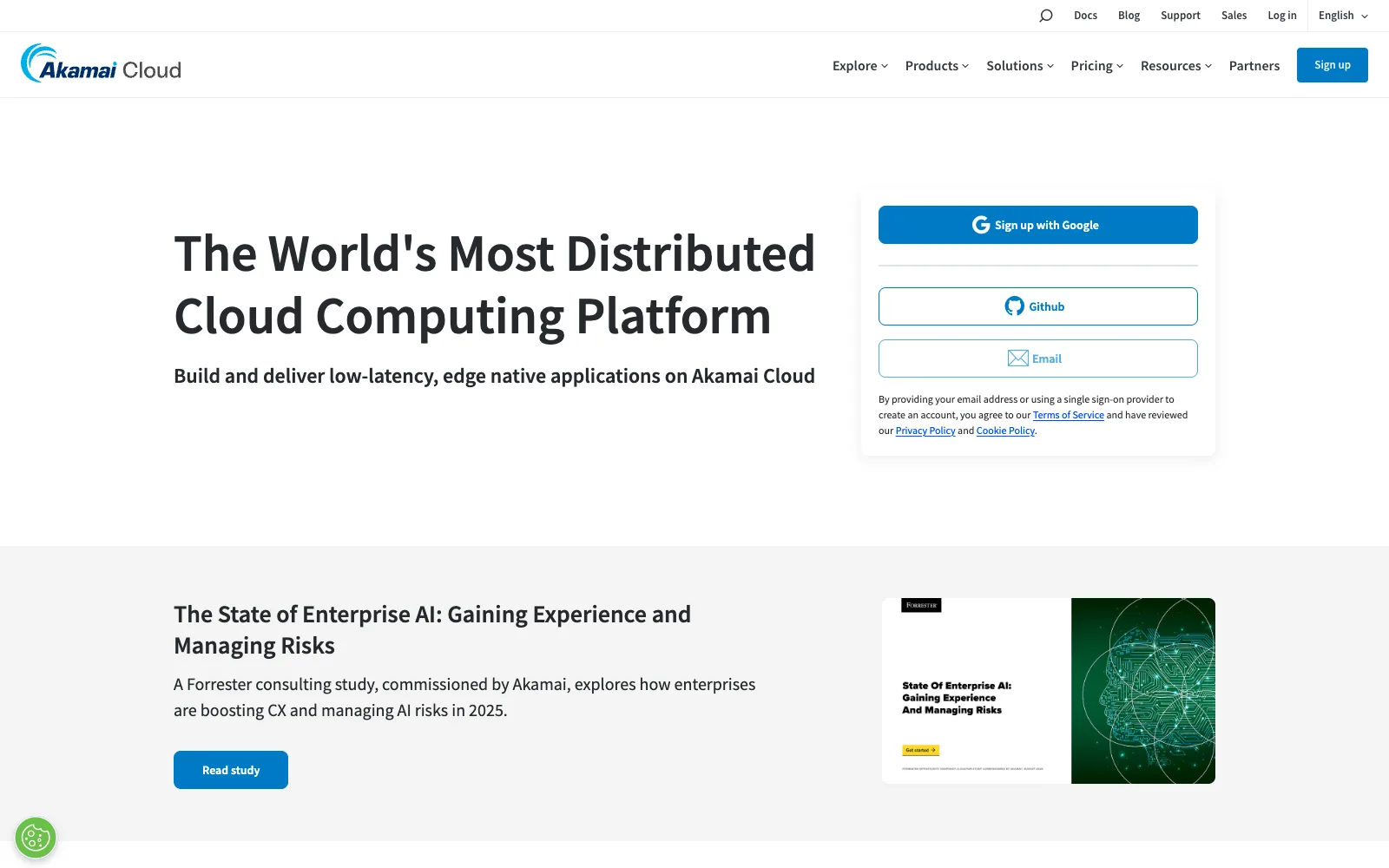
What has changed is the audience Akamai is talking to. The homepage sells a Forrester study on enterprise AI, the pricing page leads with a cost analysis form, and the new G8 Dedicated plans quietly drop bundled transfer to zero while adding faster networking. None of that affects the shared plans today, but it is the direction, and it is why Akamai sits below the three providers above it.
Who it is for: teams who want phone support and a bill they can forecast, and anyone running several small instances who benefits from pooled transfer. Pricing is at akamai.com/cloud/pricing/cpu.
What makes Hostinger the best VPS for beginners?
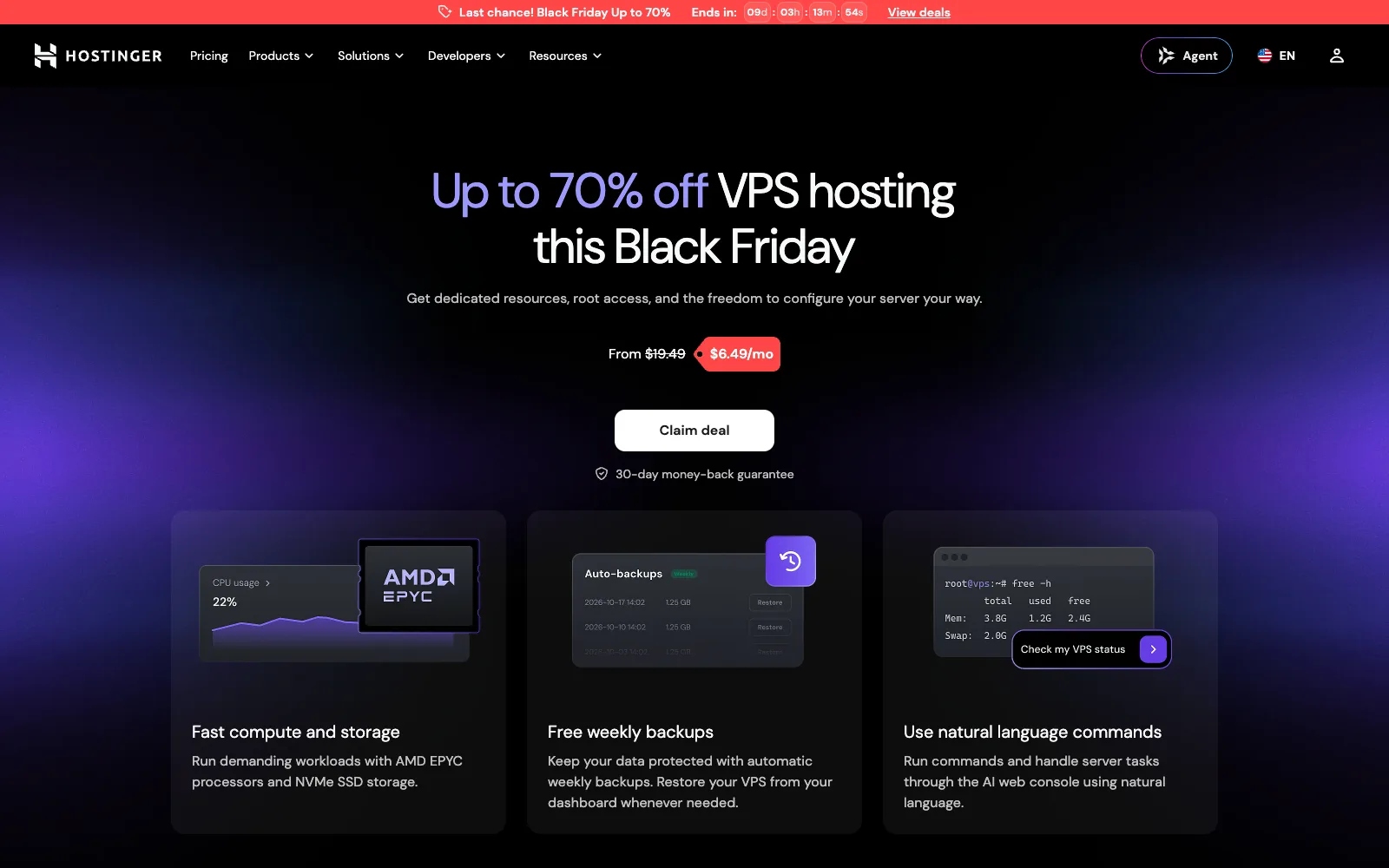
The Hostinger VPS page on Black Friday 2026, offering KVM plans from $6.49 a month on a 24 month term
Pros
The most RAM per dollar at the entry level: KVM 1 is 1 vCPU, 4 GB of RAM, 50 GB of NVMe and 4 TB of bandwidth for $6.49 a month on a 24 month plan, against a regular price of $19.49
KVM 2 (2 vCPUs, 8 GB, 100 GB NVMe, 8 TB) is $8.79 and KVM 4 (4 vCPUs, 16 GB, 200 GB NVMe, 16 TB) is $12.99 on the same terms, which undercuts everyone else here at those sizes
Free weekly backups on every plan, where the other five charge for backups or snapshots
An AI web console that accepts natural language commands, and one click templates for n8n, Dify, Docker with Traefik, Nextcloud and a long list of open source apps
AMD EPYC processors, NVMe storage, a 1 Gbps port, a public API, firewall management and a free domain for the first year
Ten data centres across four continents, and you can move a VPS between them
Cons
Every plan is paid upfront for the whole term: the $6.49 price means $155.76 today, and the $12.99 KVM 4 means $311.76
Renewals roughly double: KVM 1 renews at $11.99 a month, KVM 2 at $14.99, KVM 4 at $28.99 and KVM 8 at $49.99, so the two year cost is the number to compare
No hourly billing, so it is useless for anything short lived or experimental
The 30 day money back guarantee is the only exit; there is no scale down and refund the difference
Why we picked Hostinger
Hostinger is selling a different product from the four companies above it. They sell compute by the hour to people who already know what a reverse proxy is. Hostinger sells a two year commitment to people who want a server that runs n8n or a WordPress site and would rather type "show me what is using the disk" into an AI console than remember the command. For that audience the price is genuinely remarkable: 4 GB of RAM and NVMe for $6.49 is more machine than DigitalOcean sells for $24.
The trade is flexibility. You pay for 24 months in advance, you cannot bill by the hour, and when the term ends the price nearly doubles. Over two years KVM 1 costs $155.76, which is still cheaper than two years of a 4 GB Droplet at $24 a month ($576), so the maths works if you know you will keep the server. If you do not, the upfront payment is the wrong shape.
The Black Friday figures above were live on November 27 with a countdown showing nine days left. Hostinger runs introductory pricing most of the year, so expect a discount after the sale ends, just not necessarily 67%.
Who it is for: beginners, agencies and anyone who wants a lot of RAM for a long lived server and is comfortable paying two years upfront. Pricing is at hostinger.com/vps-hosting.
What makes Contabo the best VPS for raw resources?
Pros
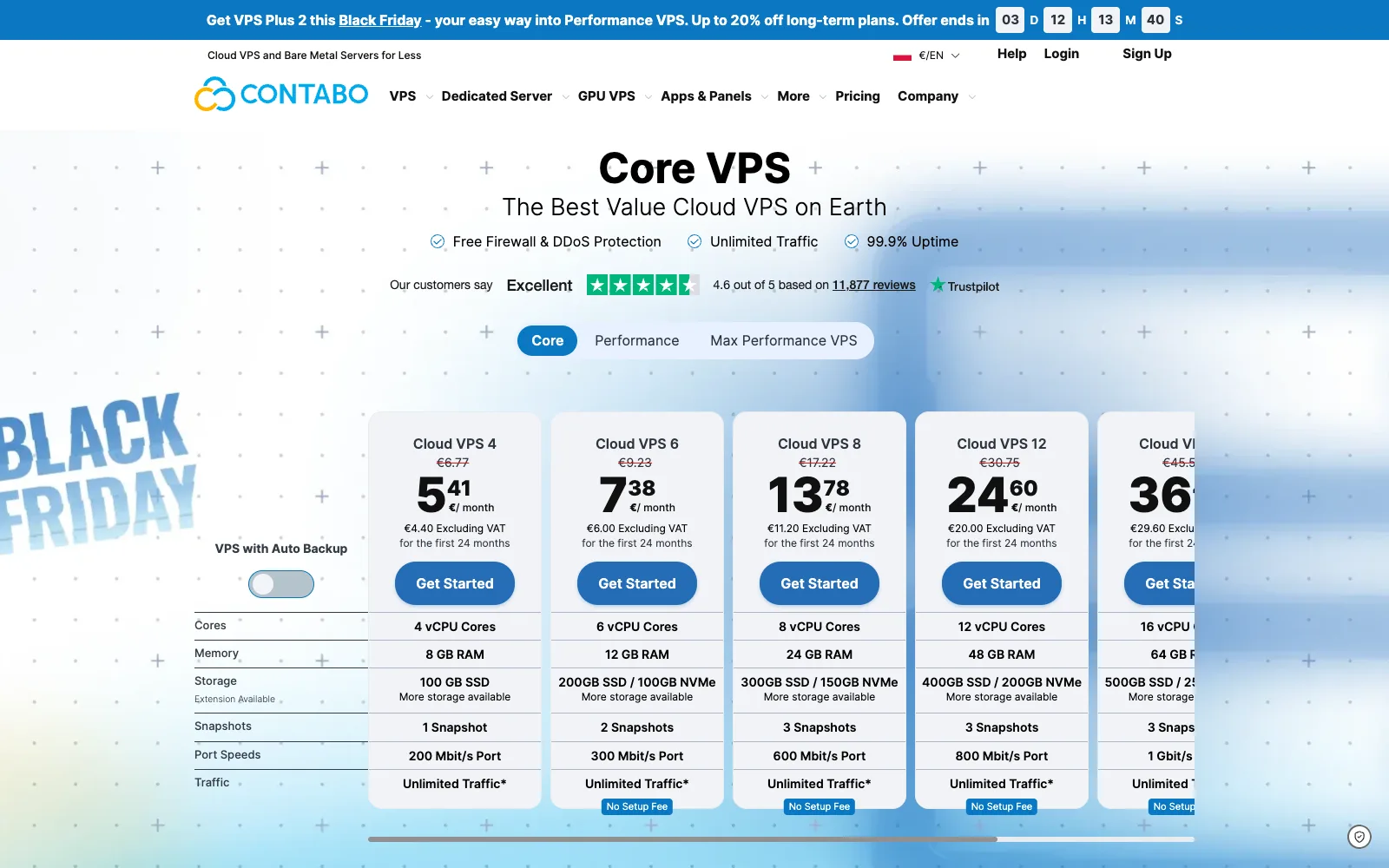
Nobody else gives you this much hardware for the money: Cloud VPS 4 is 4 vCPUs, 8 GB of RAM and 100 GB of SSD for €4.40 a month before VAT (€5.41 with German VAT), and Cloud VPS 6 is 6 vCPUs, 12 GB and 200 GB of SSD or 100 GB of NVMe for €6.00
Unlimited inbound and outbound traffic on every plan, subject to fair use, which no other provider in this list offers at any price
A free firewall, always on DDoS protection, dedicated IPv4 and IPv6 addresses and at least one snapshot included on every plan
A Performance VPS line on newer hardware for compute heavy work, plus GPU VPS, dedicated servers and storage extensions up to 1.2 TB
Custom images, cloud-init, SSH keys, an API and a CLI, so it is scriptable despite the budget positioning
Nine regions and eleven locations including the US, UK, Europe, Asia and Australia, 23 years in business and a 4.6 Trustpilot score from nearly 12,000 reviews, as displayed on the page
Cons
The port is the catch: Cloud VPS 4 ships with a 200 Mbit/s port and Cloud VPS 6 with 300 Mbit/s, where everyone else here offers 1 Gbps or more
The entry plan is SSD, not NVMe, and Contabo itself positions the Core line for "lighter workloads" with "proven" rather than current hardware
The quoted prices are for the first 24 months on a long term plan; the regular monthly price of Cloud VPS 4 is €6.77 with VAT, and setup fees apply to some plans and terms
Why we picked Contabo
Contabo answers one question better than anyone: how much VPS can I get for five euros? The answer, 4 cores and 8 GB of RAM, is roughly four times what Hetzner or DigitalOcean sell at that price, and the unlimited traffic makes it a natural home for a media server, a game server, a backup target or a cluster of development environments.
The reason it sits last is that the price assumes a lighter workload, and Contabo says so. The 200 Mbit/s port on the entry plan, the SSD rather than NVMe disk and the "proven hardware" language all point the same way: this is a lot of resources that you share with a lot of neighbours. For a Nextcloud instance or a staging server that is fine. For a latency sensitive production database it is the wrong tool, and the Performance VPS line exists for exactly that reason.
The Black Friday offer, up to 20% off long term plans with the discounted price locked for 24 months, had just over three days to run when we checked. Contabo's own pitch for it was that AI demand is pushing server prices up and a long term plan protects you from that, which is a candid thing for a host to say.
Who it is for: self hosters, hobbyists and small businesses who need RAM and bandwidth more than they need top end CPU, and who are happy with a monthly term. Pricing is at contabo.com/en/vps.
How the six providers score
The ratings in the overview table come from five criteria, each scored out of five and averaged. These are editorial judgements based on published plans, prices and allowances, not on benchmarks.
The best VPS hosting providers in 2026 are Hetzner for price and performance in Europe, DigitalOcean for documentation and managed add-ons, Vultr for the cheapest entry point and the widest choice of plan types, Akamai Cloud (the former Linode) for predictable bills and bundled transfer, Hostinger for beginners who want a lot of RAM for very little, and Contabo for the most raw resources per euro.
A VPS is still the simplest honest unit of hosting. You get a virtual machine with root access, a public IP and a monthly price, and what you run on it is your business. That is exactly why so many of the tools in our directory end up on one: a Next.js app behind Coolify, an n8n instance, a Postgres database, a Discord bot, a self hosted analytics tool. The hard part is not the server. It is choosing between six providers whose cheapest plans all cost about the same and include wildly different things.
This roundup is written for that choice. We looked at six providers, read every price from the vendor's own pricing page on November 27, 2026, and worked out what the entry plan actually includes: how many vCPUs, how much RAM, what kind of disk, how much transfer, and what the renewal looks like once the introductory price expires. Then we rated each one out of five.
One caveat before the numbers. November 27 was Black Friday, and three of the six were running sales that day. Hostinger quoted up to 70% off, Contabo up to 20% off long term plans, and DigitalOcean's homepage was pushing an inference promotion rather than Droplets at all. Where a sale price applied we quote both the sale and the regular figure, and the number at your checkout may differ.
Overview of the best VPS hosting providers
Provider
Best for
Cheapest plan
Starts at
Our rating
Hetzner
Price and performance, especially in Europe
CPX02: 1 vCPU, 1 GB RAM, 20 GB NVMe, 20 TB transfer in the EU
Entry prices cluster between four and seven dollars, so the headline figure tells you almost nothing. The table below is the comparison that matters: the same spend, the different machine.
Provider
Billing
Disk on the entry plan
Transfer included
The limit to check first
Hetzner
Hourly, capped at the monthly price
NVMe
20 TB in Germany and Finland, 1 TB in the US and Singapore
US and Singapore prices are higher and the Cost-Optimized line was sold out on the day we checked
DigitalOcean
Per second since January 1, 2026, capped monthly
SSD, NVMe on Premium Droplets from $7
500 GiB on the $4 plan, 1,000 GiB on the $6 plan
The $4 Droplet has 512 MiB of RAM, which rules out most real workloads
Vultr
Hourly, capped monthly
How we evaluated these VPS providers
Every price, plan size and included allowance in this article comes from the vendor's own website, read on November 27, 2026. Hetzner is the one exception in method rather than source: its pricing page renders prices from a public price API, and that API is what we read, so the Hetzner figures are the ones its own site displays. Where a vendor publishes a claim we could not check, such as a location count or a performance multiplier, we say it is the vendor's claim.
We rated on five things, each worth a point: what the entry plan includes for the money, how transparent the billing is (hourly and capped is best, 24 month prepayment is worst), how much transfer is bundled and what overage costs, where the servers are, and how much of a platform surrounds the VPS, meaning backups, snapshots, firewalls, private networking, managed databases and an API that Terraform can talk to.
We did not run benchmarks. A VPS roundup that quotes synthetic CPU scores from one day on one host in one region is quoting noise, and we would rather tell you what the vendor commits to in writing. Performance claims below are what each vendor publishes, not measurements of our own.
What makes Hetzner the best VPS for price and performance?
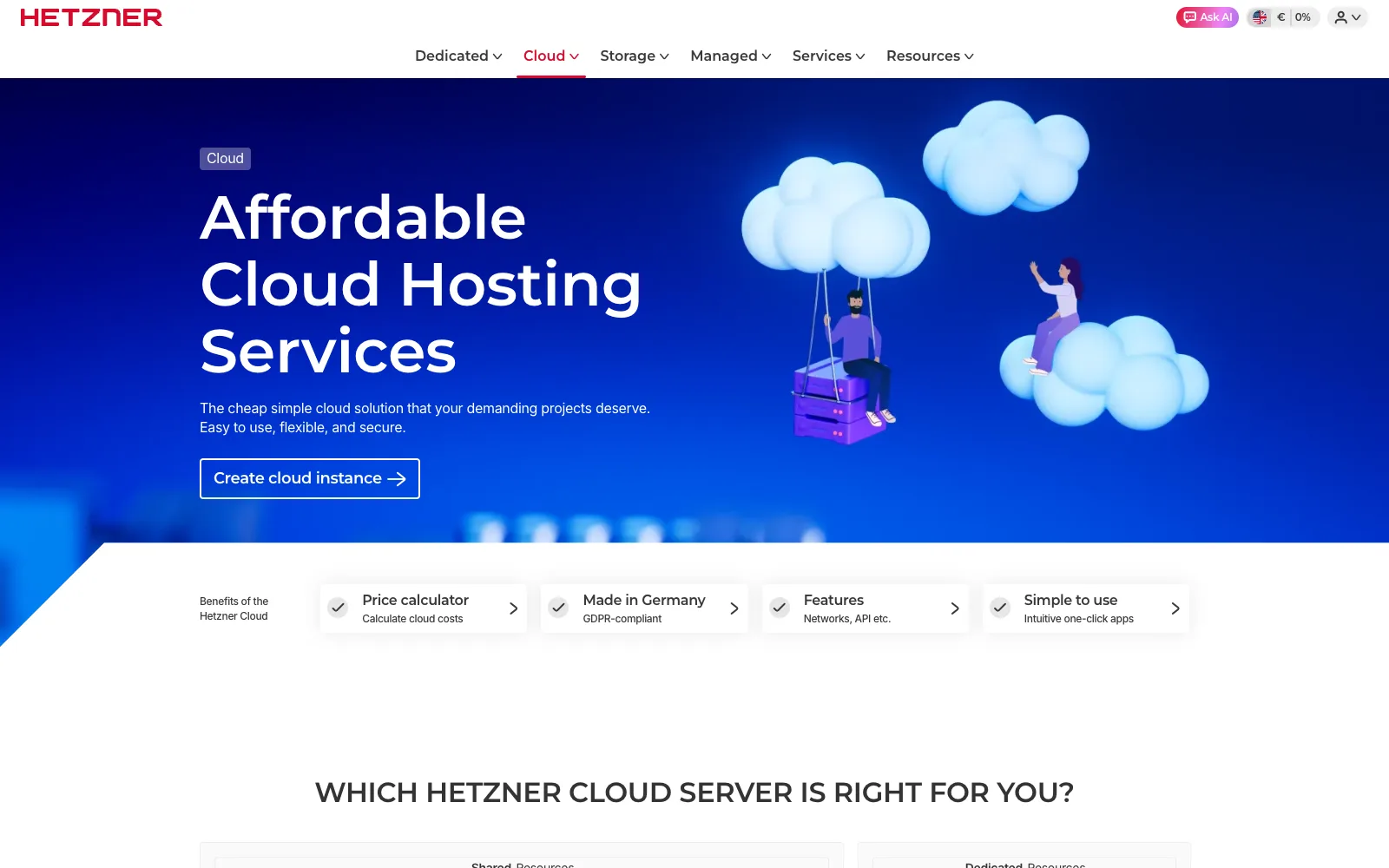
The Hetzner Cloud page, which sells shared and dedicated cloud servers from data centres in Germany, Finland, the US and Singapore
The company's attention is visibly on AI infrastructure now, and the homepage on the day we checked did not mention a Droplet above the fold
The product range is now so wide that the pricing page runs to dozens of tables, and finding the plain VPS takes scrolling
Backups and snapshots are paid add-ons
The pricing page now opens with a sales form and an egress estimator aimed at enterprise AI buyers rather than at someone who wants a $5 server
Fewer one click apps and a smaller community than DigitalOcean
Fewer infrastructure products than the cloud providers: no managed databases, object storage or load balancers to grow into
Auto backup is a paid add-on and snapshots are limited to one on the smallest plan
No hourly billing and no managed databases, Kubernetes or object storage to grow into
SSD on Regular, NVMe on High Frequency and High Performance from $6
0.5 TB on the $2.50 plan, 1 TB on the $5 plan
The $2.50 plan has no IPv4 address and runs on previous generation Intel CPUs
Akamai Cloud
Hourly, rounded up, capped monthly
SSD
1 TB on the Nanode, pooled across your account
Pricing now lives on akamai.com, and the new G8 Dedicated plans bundle no transfer at all
Hostinger
Paid upfront for the whole term
NVMe
4 TB per month
The $6.49 price needs $155.76 paid today for 24 months, and it renews at $11.99
Contabo
Monthly, with discounts for 12 and 24 month terms
SSD, NVMe from Cloud VPS 6
Unlimited, subject to fair use, on a 200 Mbit/s port
The quoted price is for the first 24 months and some plans carry a setup fee on short terms
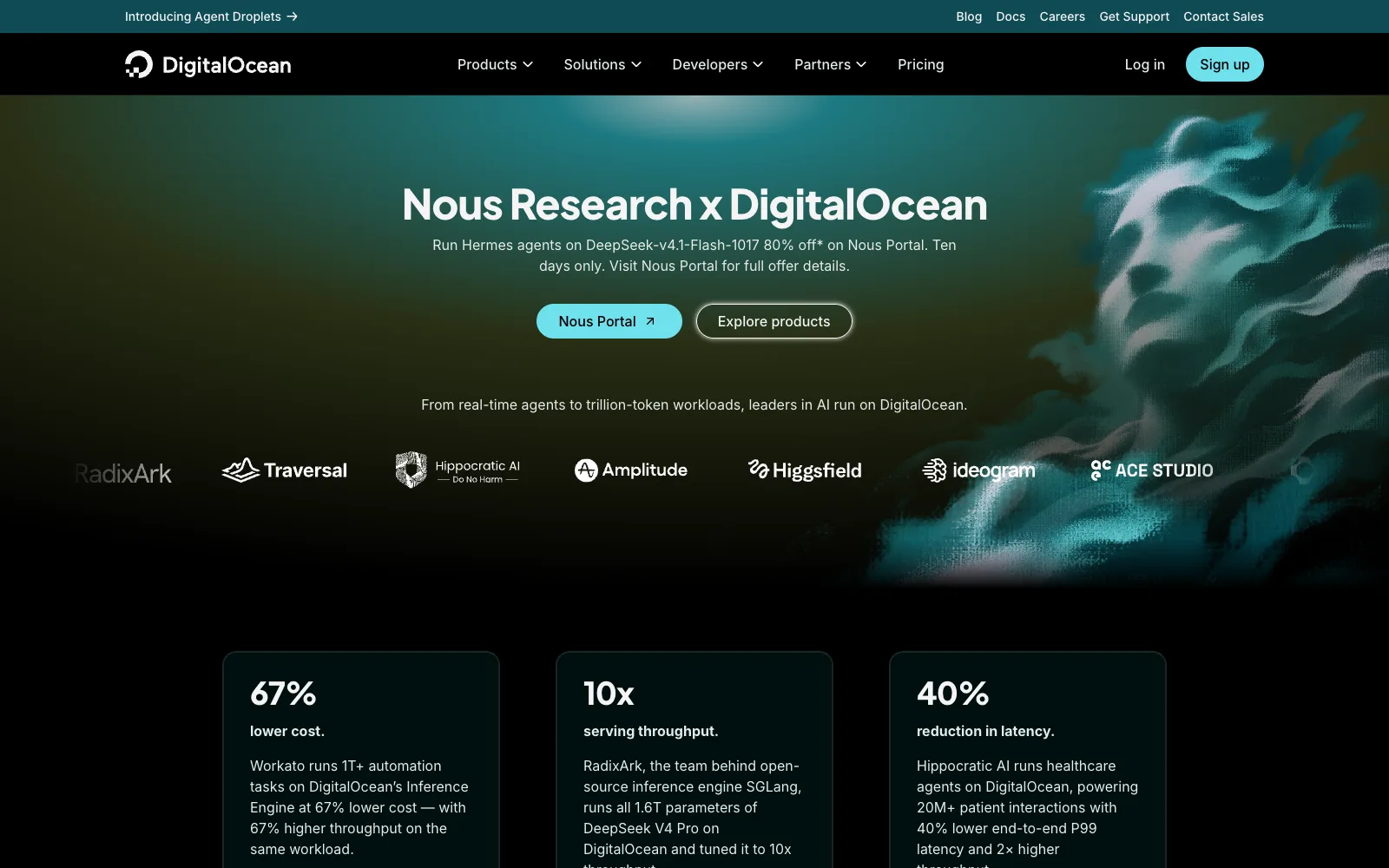
The DigitalOcean homepage, which on Black Friday 2026 was promoting AI inference and Agent Droplets ahead of its classic Droplet VPS line
The Vultr homepage, which leads with enterprise AI infrastructure but still sells cloud compute from $2.50 a month
The Akamai Cloud homepage, the platform the Linode VPS business became after Akamai acquired it
The Contabo Cloud VPS page, which sells 4 vCPUs and 8 GB of RAM from €4.40 a month before VAT
Provider
Value on the entry plan
Billing transparency
Bundled transfer
Locations
Platform around the VPS
Overall
Hetzner
5
5
5
3
4
4.6
DigitalOcean
3
5
3
4
5
4.4
Vultr
4
5
3
5
4
4.3
Akamai Cloud
3
5
4
4
4
4.1
Hostinger
5
2
4
4
3
4.0
Contabo
5
3
5
4
2
3.8
Hetzner loses points only for geography. DigitalOcean and Akamai lose them on how much machine the entry dollar buys. Vultr's transfer allowances are the thinnest of the hourly providers. Hostinger's billing model is the least flexible here, and Contabo's platform is the smallest, which matters once a project needs more than a single server.
What about OVHcloud, Scaleway, UpCloud and the free tiers?
Six providers is a list, not the market. OVHcloud and Scaleway are both serious European alternatives to Hetzner with far more locations, and UpCloud is the Finnish provider people mention when they want NVMe performance with a 100% uptime SLA. We left them out of the table because this roundup is about the entry plan a solo developer or small team actually buys, and these three price that plan at or above the providers already here, or sell it mostly to businesses.
Oracle Cloud's Always Free tier and the free credits at the hyperscalers are a different product. They are excellent for learning and for a hobby project you can afford to lose, and they are a poor foundation for anything you need to be running next year, because the terms change and the free capacity is the first thing to be reclaimed.
If you are hosting something smaller than a whole server, the managed platforms in our SaaS category may fit better than any VPS. A static site, a Postgres database or a single container does not need root access, and paying for one usually costs more in your time than in money.
How to choose a VPS provider
Start from where your users are. If they are in Europe, Hetzner is the default and everything else needs a reason. If they are spread across continents, Vultr or Akamai will serve them from closer, and DigitalOcean covers most of the same map.
Then decide how you want to pay. Hourly billing with a monthly cap, which Hetzner, DigitalOcean, Vultr and Akamai all offer, is worth a premium if you create and destroy servers often. If the server will run for two years untouched, Hostinger's upfront pricing and Contabo's 24 month rate are cheaper per gigabyte than anything the hourly providers sell, and the only thing you give up is the ability to leave early.
Check the transfer allowance before the CPU count. A server that serves video, images or downloads will exhaust DigitalOcean's 1,000 GiB or Vultr's 1 TB long before it runs out of compute, and the overage bill is what turns a $6 server into a $30 one. Hetzner's 20 TB and Contabo's unlimited traffic exist precisely for that case.
Finally, read the renewal row. On the hourly providers the price you see is the price you pay. On Hostinger it roughly doubles after the first term, and on Contabo the discounted price runs for 24 months before reverting. Neither is hidden, but both are easy to skim past on a Black Friday landing page.
Frequently asked questions
What is the cheapest VPS in 2026?
Vultr's $2.50 a month Regular Performance plan is the cheapest in this roundup, but it is IPv6 only and runs on previous generation hardware. The cheapest plan most people should actually buy is Hetzner's CPX02 at €5.49 before VAT, or Contabo's Cloud VPS 4 at €4.40 before VAT if you want resources over speed and do not mind a 24 month rate.
Is Hetzner really that much cheaper than DigitalOcean?
On hardware, yes. Hetzner's €5.49 plan and DigitalOcean's $6 plan both have 1 vCPU and 1 GB of RAM, but Hetzner's disk is NVMe and its European traffic allowance is 20 TB against DigitalOcean's 1,000 GiB. DigitalOcean's answer is the platform around the Droplet: managed databases, App Platform, the tutorial library and a far larger set of regions.
Which VPS provider has the best bandwidth allowance?
Contabo includes unlimited traffic on every plan under a fair use policy, and Hetzner includes 20 TB a month on its European servers. Akamai pools its allowances across your whole account and charges a flat $0.005 per GB over, which is the cheapest overage rate here. DigitalOcean and Vultr bundle the least at the entry level.
Should I pay 24 months upfront for a VPS?
Only if you are sure the server will still be running in two years. Hostinger's $6.49 plan costs $155.76 today and renews at $11.99 a month, and Contabo's €4.40 rate reverts after 24 months. If you might change providers, scale down or shut the project, hourly billing from Hetzner, DigitalOcean, Vultr or Akamai is cheaper in practice even at a higher monthly rate.
Do these providers charge VAT?
European providers do. Hetzner and Contabo both show prices with your local VAT applied once they know where you are, which is why this article quotes their figures before VAT and says so. DigitalOcean, Vultr, Akamai and Hostinger quote in US dollars and add tax at checkout where they are required to.
Is a VPS still worth it when Vercel, Fly.io and Railway exist?
For a single Next.js site, often not: a platform deploys it for you and the free or hobby tier covers a lot. A VPS wins when you want several things on one machine, a database you control, a long running process, a self hosted tool like n8n or Coolify, or a bill that stays flat regardless of traffic. The providers above all offer one click images for exactly that kind of stack.