Overview
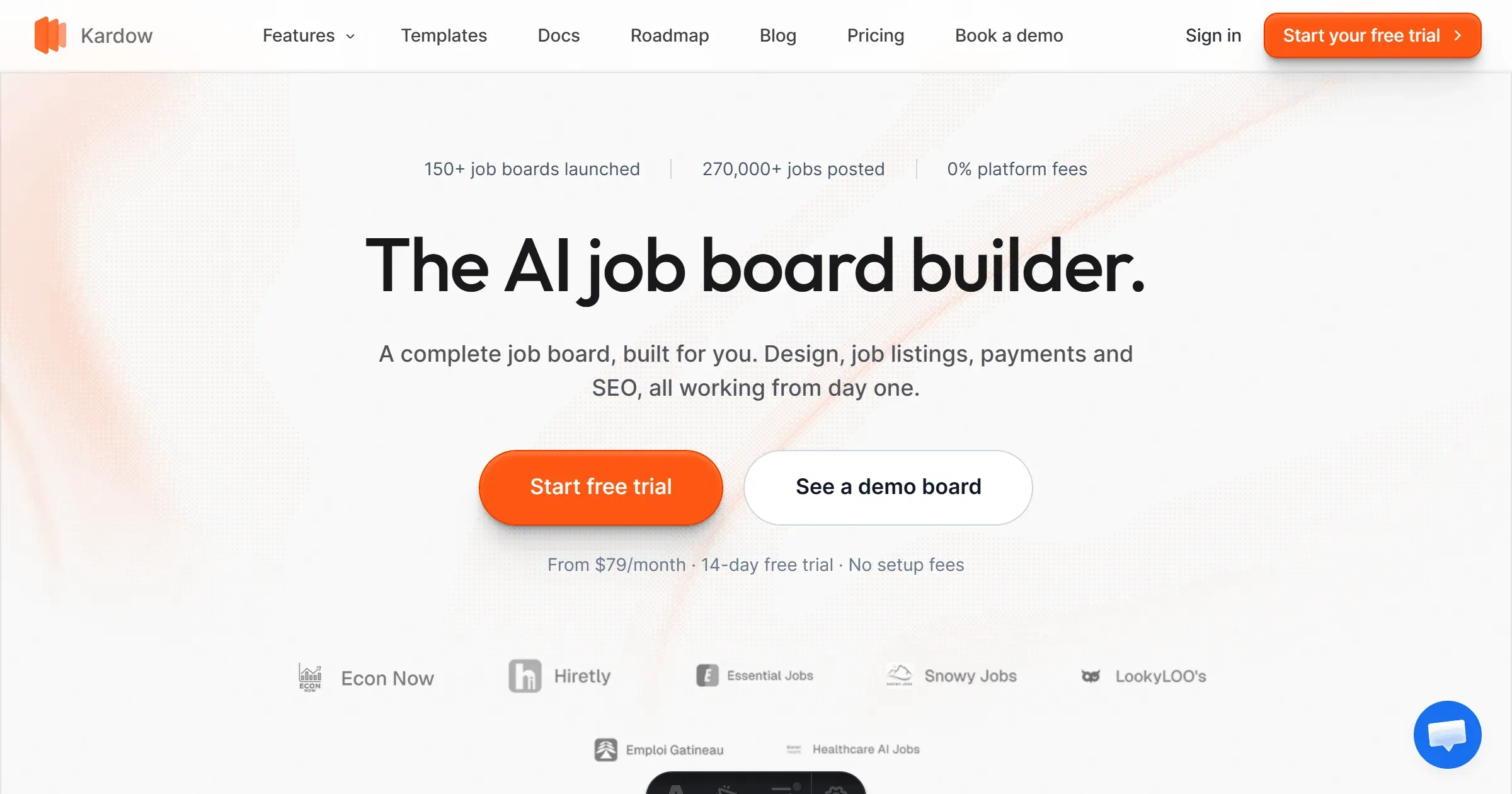
Kardow is an AI-powered job board builder that lets anyone create a fully functional, custom job board by simply describing what they want in plain language. Instead of forcing users into a rigid template or requiring a developer, Kardow generates a real Next.js application that users can customize through an AI editor or by pulling the code into their own editor. The platform includes everything needed to launch and monetize a job board: job posting and management, payment processing via Stripe, employer and candidate accounts, job imports from public sources, SEO optimization with Google for Jobs markup, and analytics.
The problem Kardow solves is straightforward. Building a job board from scratch costs tens of thousands of dollars and takes months. Template-based platforms like Niceboard or Job Boardly are cheaper but lock users into their ecosystem, take revenue cuts, and limit customization. Kardow positions itself as the middle ground, offering the flexibility of a custom build at a software subscription price. With plans starting at $79 per month, it targets entrepreneurs, recruiters, and businesses looking to launch a niche job board without technical overhead.
The target audience is broad but specific. Solo founders who want to launch a niche board quickly, recruitment agencies that need white-label solutions, developers who want a head start on client projects, and media companies looking to monetize their audience all fit the profile. Kardow is a solid alternative to Niceboard, Job Boardly, and Jooble's white-label offerings. The key differentiator is code ownership. On Pro and Scale plans, users can download their board's code via the Kardow CLI, modify anything, and deploy it back. That is a rare feature in the SaaS job board space, and it changes the calculus for anyone who has felt trapped by platform limitations before.
Key Features
- AI Editor: This is the core differentiator and the reason most people will choose Kardow. Users can type requests like "Use our brand green and round the job cards" or "Add a salary filter to the job list," and the editor applies those changes to the live board instantly. This is not a mockup or a preview. It is a real, working board that updates in real time. The AI editor handles design, layout, and even structural changes, making it accessible to non-technical users who have never touched code. For developers, it is a massive time-saver, since they can generate a base application and then refine it with natural language before diving into the code.
- Job Backfiller: A new job board is useless if it is empty, and filling it manually is tedious. Kardow's job backfiller automatically imports job listings from public career sites and job feeds, filtered by industry, keywords, and location. This ensures a new board has content from day one, which is crucial for SEO and user engagement. The feature is metered via monthly import credits, with 2,000 on Starter, 8,000 on Pro, and 25,000 on Scale. That reflects the compute cost of fetching and cleaning listings, but it is worth noting that high-volume boards may need to budget their credits carefully.
- Payments and Monetization: Kardow gives board owners multiple ways to charge for job posts: one-time posts, bundles, monthly or annual subscriptions, or a candidate paywall. Stripe integration handles card payments, and the money goes directly to the board owner. Kardow takes 0% platform fees on any plan, which is a significant advantage over competitors that take a cut of every transaction. For someone building a job board as a business, this is a big deal. The revenue model is entirely in the owner's hands.
- Employer and Candidate Accounts: Both sides get dedicated dashboards. Employers can post jobs, manage listings, and review applicants. Candidates can create profiles, upload resumes, and track applications. This creates a complete marketplace experience, not just a listing site. The two-sided nature of the platform means users do not need to bolt on separate tools for applicant tracking or employer management. It is all included.
- SEO and Analytics: Every job listing includes Google for Jobs structured data, and the platform generates sitemaps and location/category pages automatically. This is critical for getting organic traffic, since Google for Jobs is a major source of candidate discovery. Real-time analytics track page views, visitors, referrers, and clicks. The platform also supports custom domains and email sending from your domain, which helps with brand trust and deliverability. For a new board trying to gain traction, these features remove the technical barriers to ranking well.
- Customization and Code Ownership: Unlike most SaaS job board builders, Kardow gives users the ability to download their board's code on Pro and Scale plans via the Kardow CLI. This means users can modify anything, deploy it back, and truly own their application. This is a unique selling point for developers or agencies who want full control. It also means users are not locked in. If they outgrow Kardow, they can take their code and run it anywhere.
- Integrations and API: A REST API allows read/write access to jobs, applications, users, and pages. Webhooks and automations can trigger on any event, and a jobs widget can embed live jobs on external sites. There is also an MCP connector for managing the board from Claude or ChatGPT, plus Zapier integration for connecting to other tools. For anyone building a job board as part of a larger ecosystem, these integrations are essential.
How It Works
Getting started with Kardow is straightforward. Users sign up for a 14-day free trial, and no credit card is required to start, though a card is added at signup and charged only after the trial ends. They pick a template from a gallery of designer-built options, such as Studio, Starter Light, or Monoz. After choosing a template, they can connect their own domain and immediately start customizing using the AI editor.
The editor is a visual interface where users can type natural language commands to change colors, fonts, sections, or even the entire layout. For example, clicking a line like "Add a featured employers section" instantly updates the live board. Users can also edit the code directly if they prefer, using the CLI on higher tiers. The platform handles hosting, security, SSL, and updates automatically, so there is no infrastructure to manage.
For those who want a hands-off approach, the Launch Service is free on Pro and Scale plans and costs $299 one-time on Starter. It sets up the domain, email, payments, and imports the first jobs. Daily use involves managing job posts, reviewing applications, and monitoring analytics, all from a clean dashboard. The job backfiller runs automatically, so the board stays populated without manual effort. The entire workflow is designed to get a board live in hours, not weeks, and to keep it running with minimal ongoing maintenance.
Use Cases
- A solo founder launching a niche job board: Someone with no coding experience can describe their ideal board, for example, "a job board for remote marketing roles in Europe," and have it live within hours. The AI editor lets them tweak the design without touching code, and the job backfiller populates it with relevant listings immediately. The founder can start charging employers for posts on day one, turning the board into a revenue stream.
- A recruitment agency wanting a white-label board: Agencies can use Kardow to create a branded job board for their clients. The white-label capability on Pro and Scale plans, combined with custom domains and email, makes it look like a proprietary platform. They can charge employers for posts and manage everything under their own brand. This gives agencies a new service offering without a major development investment.
- A developer building a custom job board for a client: Developers can use Kardow to generate a base application, then pull the code using the CLI and extend it with custom features. This saves weeks of development time while still delivering a fully custom product. The REST API and webhooks allow deep integration with existing systems, so the board can fit into a larger software ecosystem.
- A media company or blog monetizing its audience: A site with a large readership in a specific industry can launch a job board to generate revenue. Kardow's SEO features, including Google for Jobs markup and sitemaps, help the board rank quickly, and the job backfiller ensures it is never empty. The newsletter feature collects emails and syncs with email marketing tools, building an audience that can be monetized further.
- A company building an internal career portal: Larger organizations can use Kardow to create a branded careers site that aggregates jobs from their ATS. The import feature can pull from existing feeds, and the analytics provide insights into candidate behavior. This gives HR teams a modern, customizable careers page without relying on the limitations of their ATS's built-in options.
Design & User Experience
Kardow's website presents a clean, modern, and professional aesthetic. The design language is consistent with what you would expect from a contemporary SaaS product, with a focus on clarity and ease of navigation. The dashboard is organized logically, with clear sections for jobs, applications, analytics, and settings. The AI editor is the standout design decision, and it is presented as the centerpiece of the product. The interface for it is intuitive, with a chat-like input where users type commands and see results immediately.
The learning curve appears to be gentle for non-technical users, thanks to the AI editor and the template gallery. The templates themselves are designer-built and look polished out of the box. The platform also handles technical details like SSL, hosting, and custom domains automatically, which removes the most intimidating parts of launching a web application. Mobile responsiveness is a given in modern web design, and Kardow appears to follow that standard, though the admin dashboard is clearly designed for desktop use. One potential rough edge is that the AI editor, while powerful, may not handle extremely complex customizations without some manual code editing. Users who want truly unique layouts or features may still need to get their hands dirty.
Pricing & Value
Kardow offers three main plans, all with a 14-day free trial and no setup fees. The Starter plan is $79 per month, or $59 per month billed annually. It includes one board, 2,000 import credits per month, one team seat, and core features like the AI editor, custom domain, and the ability to charge for job posts. This plan is best suited for someone testing a job board idea or launching a small niche board.
The Pro plan is $179 per month, or $134 per month billed annually. It adds white-label branding, custom email domains, subscriptions and paywall, Google login, custom fields, AI screening questions, REST API access, and 8,000 import credits. This is the sweet spot for most serious users, since it includes the code ownership and white-label features that set Kardow apart.
The Scale plan is $379 per month, or $284 per month billed annually. It includes 25,000 import credits, unlimited team seats, invoicing, priority support, and up to three separate boards. This is for agencies or companies running multiple boards. A Launch Service is available for $299 one-time on Starter but is free on Pro and Scale.
Compared to competitors like Niceboard, which starts around $40 per month but takes a 5% platform fee, Kardow's pricing is higher on the surface. However, the 0% platform fee and the code ownership features change the value equation. For a board that processes significant revenue, the lack of transaction fees can more than offset the higher subscription cost. Custom development, which can cost $30,000 or more, is not even in the same ballpark. For anyone serious about launching a job board, the pricing is reasonable.
Who Is Kardow Best For?
Kardow is best for three specific user segments. First, solo founders and entrepreneurs who want to launch a niche job board quickly without learning to code. The AI editor and job backfiller remove the two biggest barriers to entry, and the 0% platform fee means they keep all their revenue. Second, recruitment agencies that want a white-label board to offer their clients. The Pro plan's white-label capability, custom domains, and email make it look like a proprietary platform, which is a strong selling point. Third, developers and agencies building job boards for clients. The ability to generate a base application and then pull the code via the CLI saves weeks of development time while still delivering a fully custom product.
On the other hand, someone who needs a completely free job board or who is only posting a handful of jobs for their own company might find the pricing hard to justify. A simple ATS or a free listing site might be sufficient. Additionally, users who want extremely complex, bespoke functionality that goes far beyond what the AI editor can handle may still need a custom development project. Kardow is a powerful tool, but it is not a replacement for a full engineering team when the requirements are highly unusual.