Alternative.tools
CategoryGuidesHow-toBlogPricing
Submit your Website
Alternative.tools
Submit
Alternative.tools

Alternative.tools is an independent platform dedicated to unbiased reviews of newly launched websites, tools, and products — analyzing everything from their features to their full potential. Our goal is to be objective, simple, and your first stop when researching a new tool to grow your business, helping you discover great alternatives to the ones you already use.

Helping founders and makers get discovered.

Product
  • Submit Website
  • Pricing
  • Categories
Guides
  • All Guides
  • How-to Playbooks
  • Best for…
  • Directory Submission
  • AI / LLM APIs
  • Reddit Marketing
  • Stripe Alternatives
  • SEO Tools
Resources
  • About Us
  • Submission Guidelines
  • Glossary
  • Blog
  • SaaS Payments
  • Google Graveyard
  • Sitemap
  • LLMs.txt
Legal
  • Privacy Policy
  • Terms of Service
  • Cookie Policy
  • Contact
© 2026 Alternative.tools

On this page

  • Overview
  • How to choose
  • Comparison
  • Feature comparison
  • DataFast
  • Plausible
  • Fathom
  • PostHog
  • Google Analytics 4
  • FAQ
  • The verdict
Summarize with AI
Web Review

Web Review

Ad

The website review directory that helps you rank on Google, ChatGPT, Claude, Gemini & Perplexity with dofollow backlinks and AI reviews.

HomeGuidesBest Analytics Tools for SaaS in 2026

Best Analytics Tools for SaaS in 2026

Five analytics platforms compared for SaaS founders who want to know what actually drives signups and revenue.

Updated August 2026
Share:

On this page

  • Overview
  • How to choose
  • Comparison
  • Feature comparison
  • DataFast
  • Plausible
  • Fathom
  • PostHog
  • Google Analytics 4
  • FAQ
  • The verdict
Summarize with AI
Web Review

Web Review

Ad

The website review directory that helps you rank on Google, ChatGPT, Claude, Gemini & Perplexity with dofollow backlinks and AI reviews.

Key takeaways

  • 1. DataFastRevenue analytics for founders

    Solo founders and small SaaS teams who want to see exactly which traffic sources drive revenue without configuring a complex analytics stack.
Visit DataFast
  • 2. PlausibleLightweight privacy-first analytics

    Teams that want simple, compliant traffic analytics without cookie banners or a heavy tracking script slowing down their site.

  • 3. FathomSimple privacy-first analytics

    Privacy-focused founders who want a clean, compliant analytics dashboard and are happy to skip deep product tracking.

  • 4. PostHogProduct analytics suite

    Product-led SaaS teams that need event tracking, funnels, session replay and feature flags in a single open-source platform.

  • 5. Google Analytics 4Free but complex analytics

    Teams that need free, deep reporting and are willing to invest time in configuration and privacy compliance.

  • Overview

    Most SaaS analytics tools tell you how many people visited. Far fewer tell you which visits turned into paying customers. In 2026 the tools worth paying for are the ones that connect traffic to revenue, respect user privacy, and stay simple enough that you actually check them.

    We compared five popular options across privacy, revenue attribution, product analytics and price. DataFast leads for founders who want revenue clarity without a data team, while Plausible and Fathom keep things lightweight, PostHog goes deep on product behavior, and GA4 remains the free heavyweight for those who can stomach the complexity.

    How to choose

    Before you pick, weigh these against your own situation — the right choice depends on your stage, budget, and goals.

    • Event model & tracking — Prefer tools with a clean event/property schema and autocapture or a solid SDK, since sloppy instrumentation upfront poisons every downstream report.

    • Product vs marketing scope — Decide whether you need product analytics (funnels, retention, cohorts) or web analytics (traffic, attribution), and pick a tool that leads in that area rather than doing both weakly.

    • Cohort & retention depth — Look for flexible cohort building and retention curves, because for SaaS the real signal is whether users come back, not raw pageviews.

    • Warehouse integration — Choose a tool that syncs to or sits on your data warehouse (BigQuery, Snowflake) so you own the raw data and can join it with billing and CRM.

    • Pricing at scale & privacy — Model the cost as your event volume grows and confirm GDPR/cookie-consent handling, since MTU or event-based pricing can spike unexpectedly and compliance is non-negotiable.

    Comparison at a glance

    ToolBest forFree tierStarts atStandout
    DataFastIndie SaaS foundersTrial available$19/mo (verify)Ties traffic to revenue
    PlausiblePrivacy-conscious teamsTrial available$9/mo (verify)No cookie banner needed
    FathomSmall businessesTrial available$15/mo (verify)Compliance without cookies
    PostHogProduct-led SaaSGenerous free tierUsage-based (verify)Funnels, replay, flags
    Google Analytics 4Data-heavy teamsFreeFree (verify)Powerful, free, ubiquitous

    Pricing and features change often — verify current details on each provider's site. Last checked August 2026.

    Feature comparison

    FeatureDataFastPlausibleFathomPostHogGoogle Analytics 4
    Privacy-friendly / cookielessPartial
    Revenue attributionPartial
    Product analytics (funnels/events)Partial
    Session replay
    Open source
    Free tierPartial

    "Partial" means available via add-on, in beta, or more limited than competitors.

    DataFast

    Revenue analytics for founders
    Visit DataFast

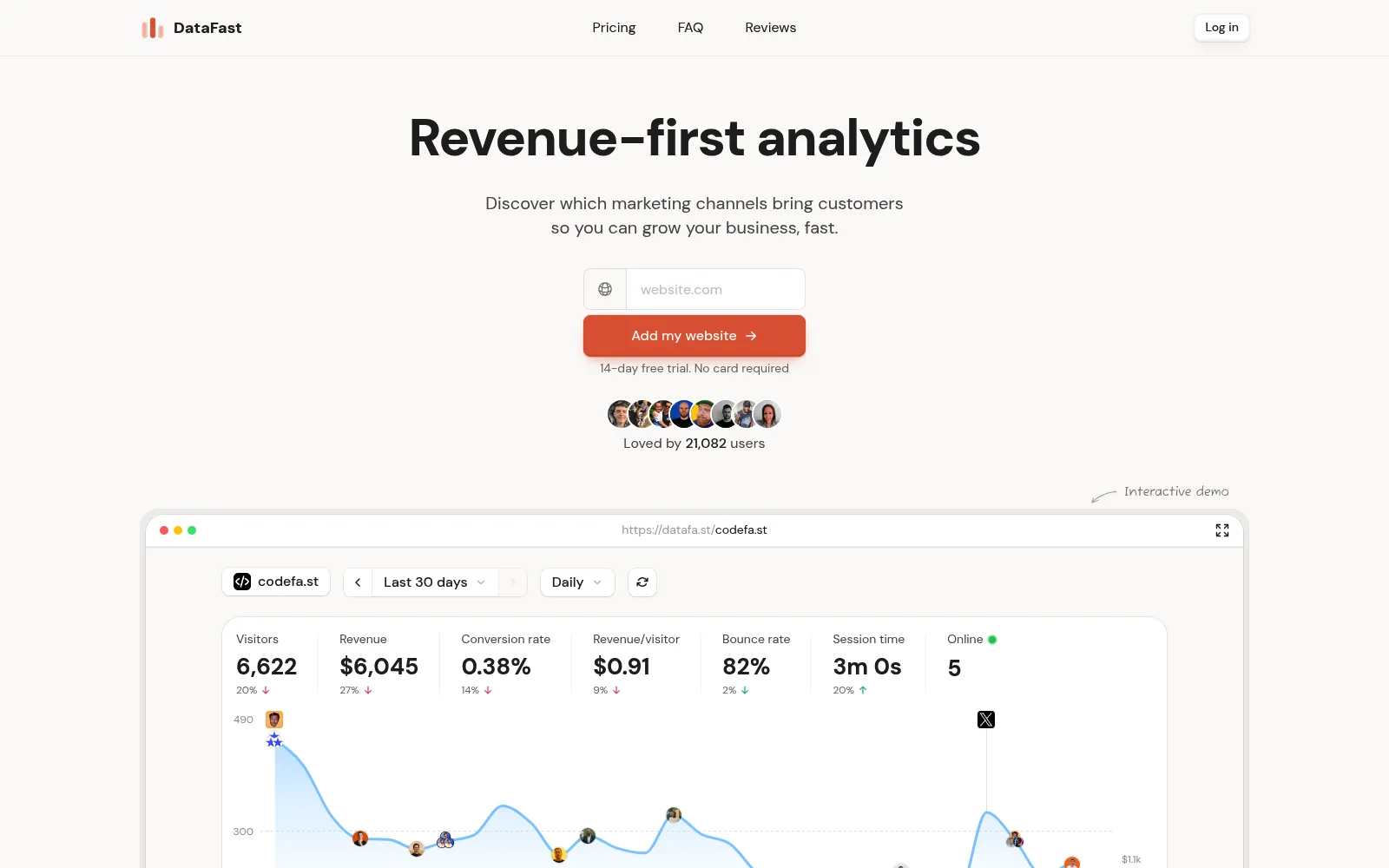
    DataFast is built for one job that most analytics tools ignore: showing SaaS founders which marketing actually makes money. Instead of drowning you in pageviews, it connects each visitor to signups, trials and revenue, so you can see that a blog post or a Reddit thread turned into real MRR rather than just a spike in traffic.

    It is privacy-friendly and refreshingly simple to set up, which makes it ideal for indie founders and small teams who do not have an analyst on staff. The dashboard is designed around growth decisions, so you spend less time interpreting charts and more time doubling down on the channels that convert.

    Best for: Solo founders and small SaaS teams who want to see exactly which traffic sources drive revenue without configuring a complex analytics stack.
    Pros

    • Directly attributes traffic to signups and revenue
    • Privacy-friendly and fast to install
    • Clean dashboard aimed at growth decisions
    • Purpose-built for SaaS founders, not enterprises

    Cons

    • Younger product than the incumbents
    • Less suited to deep product event tracking
    • Smaller integration catalog
    • Not a free-forever plan
    Visit DataFast

    Plausible

    Lightweight privacy-first analytics
    Visit Plausible

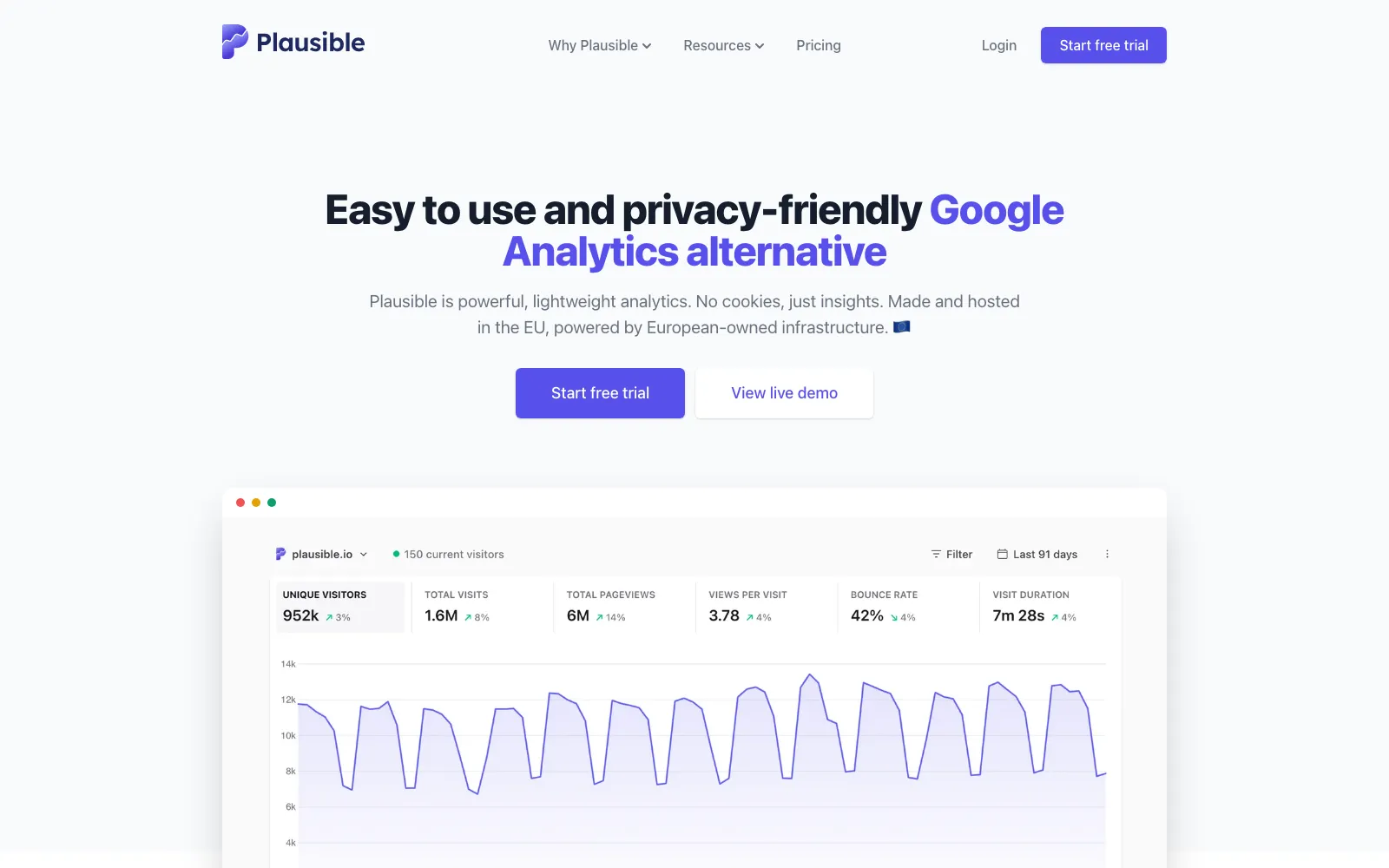
    Plausible is a lightweight, privacy-first web analytics tool that gives you the essential traffic numbers on a single, easy-to-read dashboard. It is GDPR-friendly and cookieless by design, so you can run it without a cookie banner and without collecting personal data.

    The script is tiny and loads fast, making it a favorite for marketing sites and content-heavy SaaS pages where performance matters. It is open source and can be self-hosted, though the hosted plan removes the maintenance burden.

    Best for: Teams that want simple, compliant traffic analytics without cookie banners or a heavy tracking script slowing down their site.

    Pros

    • Cookieless and GDPR-friendly out of the box
    • Tiny, fast-loading script
    • Simple single-page dashboard
    • Open source and self-hostable

    Cons

    • No built-in revenue attribution
    • Limited product analytics
    • No session replay
    • Fewer advanced segments than heavier tools
    Visit Plausible

    Fathom

    Simple privacy-first analytics
    Visit Fathom

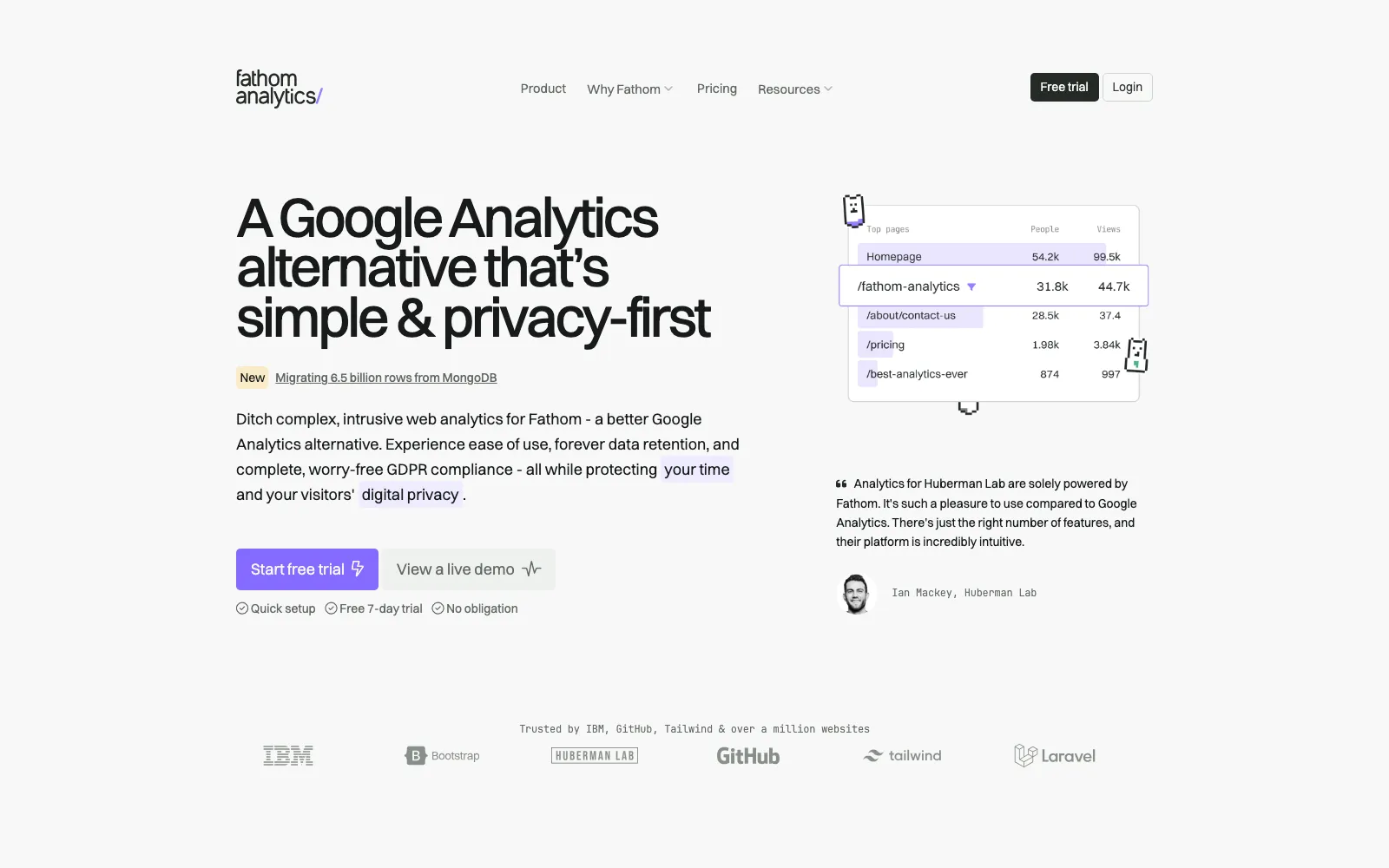
    Fathom is another lightweight, privacy-first analytics option that focuses on giving you clear traffic insights without tracking individuals. It is GDPR-friendly and cookieless, so like Plausible it removes the need for a cookie consent banner.

    The appeal is simplicity and compliance in one package: a clean dashboard, fast script, and a strong stance on not selling or sharing data. It suits founders who want trustworthy numbers and peace of mind on privacy regulations.

    Best for: Privacy-focused founders who want a clean, compliant analytics dashboard and are happy to skip deep product tracking.

    Pros

    • Cookieless and GDPR-friendly
    • Fast, lightweight tracking script
    • Uncomplicated dashboard
    • Strong privacy and data ownership stance

    Cons

    • No native revenue attribution
    • Minimal product analytics
    • No session replay
    • Less granular than product-focused tools
    Visit Fathom

    PostHog

    Product analytics suite
    Visit PostHog

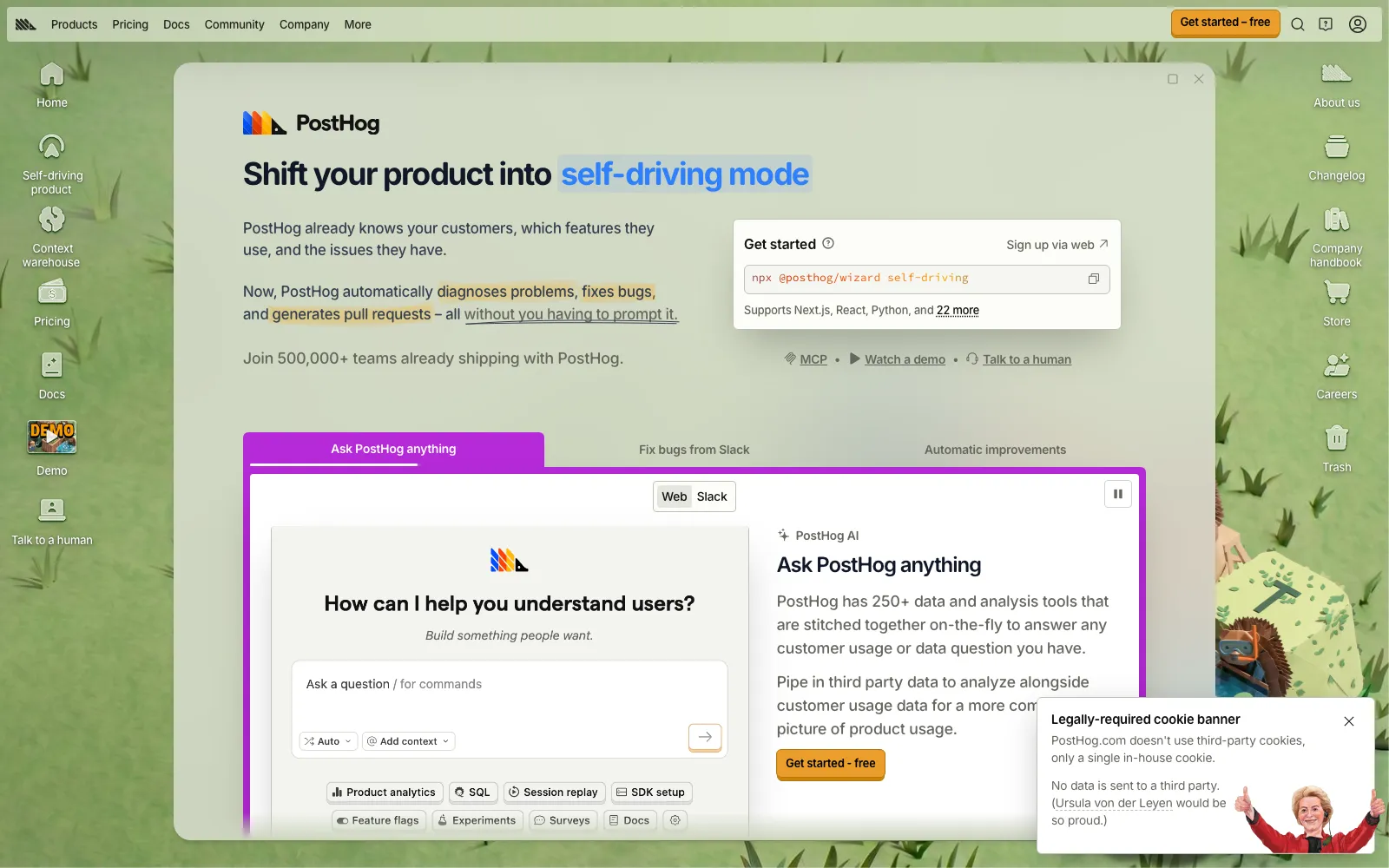
    PostHog is a full product analytics suite covering events, funnels, session replay and feature flags in one platform. It is built to answer how users actually move through your product, where they drop off, and which features drive retention.

    It offers a generous free tier and is open source, which makes it popular with product-led SaaS teams who want depth without an enterprise contract. The trade-off is more setup and a steeper learning curve than the simple traffic tools.

    Best for: Product-led SaaS teams that need event tracking, funnels, session replay and feature flags in a single open-source platform.

    Pros

    • Deep product analytics with funnels and events
    • Session replay and feature flags included
    • Generous free tier
    • Open source and self-hostable

    Cons

    • Steeper learning curve
    • More setup than lightweight tools
    • Usage-based pricing can scale up fast
    • Overkill for simple marketing sites
    Visit PostHog

    Google Analytics 4

    Free but complex analytics
    Visit Google Analytics 4

    Google Analytics 4 is the free, powerful default that almost everyone has access to. It offers deep reporting, cross-platform tracking and integrations across the Google ecosystem, which is hard to match at zero cost.

    The downside is complexity and privacy. GA4 has a notoriously steep learning curve, relies on data sampling, and carries privacy concerns that often require cookie banners and careful configuration to stay compliant.

    Best for: Teams that need free, deep reporting and are willing to invest time in configuration and privacy compliance.

    Pros

    • Completely free to use
    • Powerful, flexible reporting
    • Tight Google ecosystem integrations
    • Ubiquitous with abundant documentation

    Cons

    • Steep learning curve and complex UI
    • Privacy-heavy, often needs cookie banners
    • Data sampling on large sites
    • No direct SaaS revenue attribution out of the box
    Visit Google Analytics 4

    Frequently asked questions

    What is the best analytics tool for a SaaS founder?+

    For founders who care most about growth, DataFast is the standout because it ties traffic directly to signups and revenue in a simple, privacy-friendly dashboard. If you mainly need lightweight traffic stats, Plausible or Fathom work well, and PostHog is better if you need deep product analytics.

    Which analytics tools are privacy-friendly and GDPR compliant?+

    DataFast, Plausible and Fathom are all privacy-friendly. Plausible and Fathom are cookieless and GDPR-friendly, so they typically do not require a cookie banner. GA4 is the most privacy-heavy option and usually needs consent management to stay compliant.

    Do any of these tools connect analytics to revenue?+

    DataFast is designed specifically to connect traffic to signups, trials and revenue, which is its core strength. PostHog can approximate this with events and custom setup, while Plausible, Fathom and GA4 do not offer native SaaS revenue attribution out of the box.

    Is Google Analytics 4 still worth using in 2026?+

    GA4 remains worthwhile if you want a free, powerful tool with deep reporting and Google ecosystem integrations. The trade-offs are a steep learning curve and privacy concerns, so many SaaS founders pair or replace it with a simpler, privacy-first tool.

    Which tool has the best free tier?+

    PostHog offers a generous free tier for product analytics and GA4 is free to use, though complex. Plausible and Fathom are paid after a trial, and DataFast offers a trial before its paid plans.

    The verdict

    For most SaaS founders, DataFast is the best starting point because it answers the question that actually matters: which traffic turns into revenue, all in a simple privacy-friendly dashboard. Choose Plausible or Fathom if you only need lightweight compliant traffic stats, reach for PostHog when you need deep product analytics and session replay, and keep GA4 if you want free, powerful reporting and can handle its complexity.

    Related guides

    Guide · DirectoriesBest Directory Submission Services in 2026Guide · SaaSHow to Start a SaaS in 2026Guide · AIHow to Start an AI Startup in 2026Guide · BloggingHow to Start a Blog in 2026
    Alternative.tools

    Alternative.tools review team

    We are the editorial team behind Alternative.tools, an independent platform for unbiased reviews of newly launched websites, tools, and products. We test tools hands-on, track pricing and features as they change, and publish practical comparisons and how-to playbooks so you can choose the right tool faster, without the marketing spin.

    About usAll guidesHow-to playbooks

    Sources — official pricing/docs:

    DataFastPlausibleFathomPostHogGoogle Analytics 4

    Building a SaaS? Submit it to the directory to get discovered.